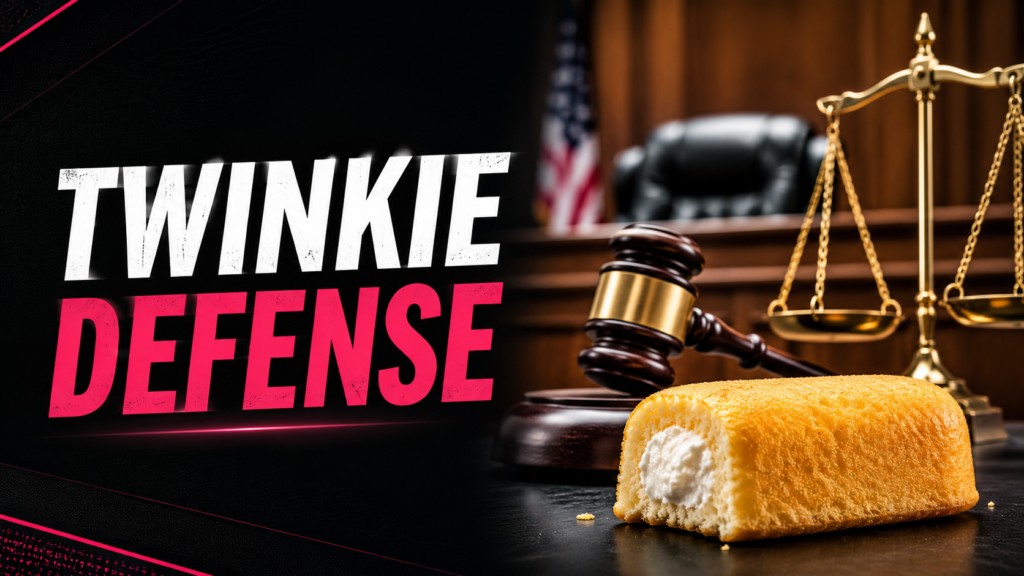

Most people think they know the twinkie defense. They picture a lawyer standing before a jury, arguing that a snack cake made a man kill two political leaders. The story has become one of the most durable urban legends in American law. It shows up in movies, late-night jokes, and casual conversation whenever someone wants to mock a supposedly ridiculous courtroom argument.
The reality is more complex and more interesting. The twinkie defense never claimed that Twinkies caused murder. Instead, it was a media nickname for a carefully constructed diminished capacity defense presented in the 1979 trial of former San Francisco Supervisor Dan White. White had shot and killed Mayor George Moscone and Supervisor Harvey Milk. His lawyers argued that severe depression had robbed him of the mental capacity needed for first-degree murder. Junk food appeared in the testimony only as one symptom among many.
This article examines the actual legal strategy, the psychiatric evidence, the political atmosphere of late-1970s San Francisco, the jury’s decision, and the lasting changes the case forced on California criminal law. By separating myth from record, readers gain a clearer view of how mental-state defenses work, how media can reshape public understanding, and why the phrase “twinkie defense” still carries power decades later.
The Political Backdrop: San Francisco in 1978
San Francisco in the late 1970s was a city of sharp political and cultural divides. The Board of Supervisors included progressive figures such as Harvey Milk, the first openly gay elected official in a major American city, and more conservative voices like Dan White, a former police officer and firefighter. White represented a working-class district and often clashed with the liberal majority on issues ranging from development to social policy.
In November 1978 White resigned his seat, citing financial pressure and the demands of the job. Days later he asked Mayor George Moscone to reappoint him. Milk and other supervisors urged Moscone to choose a more progressive replacement. On the morning of November 27, White learned that the mayor would not give him the seat back. He entered City Hall through a basement window (avoiding metal detectors), went to Moscone’s office, and shot the mayor. He then reloaded, walked to Milk’s office, and shot him as well. White surrendered shortly afterward.
The killings shocked the city. Milk had become a national symbol for gay rights. Moscone had been a popular mayor with strong progressive credentials. White’s background as a police officer and firefighter complicated public reaction. Some residents viewed him as a product of the same system that now judged him. Others saw cold-blooded political assassination. The trial that followed would test California’s rules on mental state and intent.
What Is Diminished Capacity?
Before examining the trial strategy, it helps to understand the legal tool White’s lawyers used. Diminished capacity was a doctrine available in California at the time. It allowed defendants to introduce evidence that a mental condition (illness, intoxication, trauma, or other impairment) prevented them from forming the specific mental state required for a charged crime.
First-degree murder in California required proof of willfulness, deliberation, and premeditation. If the defense could raise a reasonable doubt about any of those elements, the jury could convict on a lesser included offense such as second-degree murder or voluntary manslaughter. Voluntary manslaughter covered killings committed in the heat of passion or during a sudden quarrel, or when the defendant acted without malice because of diminished capacity.
This was distinct from the insanity defense. Insanity, under the then-prevailing M’Naghten rule, asked whether the defendant knew the nature and quality of the act or that it was wrong. Diminished capacity focused more narrowly on the ability to form specific intent. It did not require a finding that the defendant was legally insane. It simply asked whether the mental condition reduced the defendant’s capacity enough to negate an element of the higher crime.
California courts had recognized versions of the doctrine since the late 1940s. By 1979 it had become a standard tool in homicide cases involving psychiatric evidence. The Dan White trial would push public and legislative tolerance for the doctrine to its limit.
Building the Defense: Depression as the Central Theme
Defense attorney Douglas Schmidt faced an obvious problem. White had confessed. He had entered City Hall covertly, carried a loaded revolver, and shot two men at close range, firing additional shots into each body after they fell. Premeditation seemed apparent. Schmidt therefore did not contest the physical acts. He focused entirely on White’s mental state in the months leading up to the shootings.
The defense presented a portrait of a man in deepening depression. White had been a high-achieving, disciplined individual: a military veteran, a police officer, a firefighter, and a family man who maintained a rigorous exercise routine and a health-conscious diet. In the months before the killings, according to testimony, that pattern collapsed.
Witnesses described withdrawal from family and colleagues. White slept poorly. He stopped exercising. He neglected his appearance. He called in sick from work. He became irritable and isolated. Financial strain from his political resignation added pressure. The defense argued these changes reflected recurrent depressive episodes that White had experienced for years but never treated.
Psychiatrists retained by the defense examined White and reviewed his history. Dr. Martin Blinder, Dr. George Solomon, Dr. Donald Lunde, and others testified that White suffered from severe depression. They described him as operating in a state of reduced capacity on the day of the shootings: unable to deliberate maturely, unable to reflect meaningfully on the gravity of his actions, and acting in a dissociated or “automatic pilot” mode.
The junk-food detail entered the record almost as a footnote. Blinder noted that when White felt things going wrong, he abandoned his usual nutrition and began “gorging himself on junk foods: Twinkies, Coca-Cola.” Blinder presented the dietary shift as one observable symptom of depression, comparable to changes in sleep, grooming, or social withdrawal. He did not claim that sugar caused the killings. He did mention, in passing, research suggesting that high-sugar diets could affect mood in susceptible people. That brief remark later fueled the media nickname.
Other symptoms received equal or greater emphasis: insomnia, lethargy, withdrawal from wife and child, neglect of personal appearance, and a pattern of depressive episodes lasting several days at a time. The defense also pointed to the intense political and personal stress surrounding White’s resignation and failed attempt at reinstatement.
The prosecution presented its own psychiatric expert, who disagreed with the defense conclusions. Prosecutors argued that White’s actions (climbing through a window to avoid detection, reloading between victims, targeting specific political rivals) demonstrated clear planning and intent. They portrayed the depression evidence as exaggerated or self-serving. The jury ultimately accepted enough of the defense theory to reject first-degree murder.
How the Media Created the Twinkie Defense Myth
Courtroom reality and public perception diverged almost immediately. Reporters covering the trial seized on the most colorful detail. The phrase “Twinkie defense” began circulating in news accounts. Satirist Paul Krassner later claimed credit for popularizing the term. Headlines and columns reduced the complex psychiatric testimony to a simple, absurd-sounding claim: the defendant ate too many Twinkies and therefore could not form murderous intent.
The distortion stuck. In the popular imagination, White’s lawyers had argued that sugar high or junk-food addiction caused the double homicide. That version appeared in later films, television references, and casual legal commentary. The actual trial record shows otherwise. Junk food occupied a minor place in the evidence. Depression, behavioral change, and inability to deliberate formed the core of the argument.
Snopes and other fact-checking outlets have repeatedly labeled the causal claim false. The term itself became a derisive label for any improbable or unconventional defense strategy. Even U.S. Supreme Court Justice Antonin Scalia later used the phrase in oral argument as shorthand for creative lawyering. The nickname outlived the precise facts of the case.
This media transformation illustrates a recurring pattern in high-profile trials. Complex testimony about mental state is difficult to summarize. A single concrete image (a snack cake) is easy to remember and easy to ridicule. The result is an urban legend that continues to shape how the public understands mental-state defenses.
The Verdict, Sentence, and Immediate Aftermath
On May 21, 1979, after roughly 36 hours of deliberation, the jury returned its verdict: not guilty of murder, guilty of two counts of voluntary manslaughter. Judge Walter Calcagno imposed the maximum sentence then available: seven years and eight months in prison. White served approximately five years before parole.
The verdict triggered immediate and intense reaction. That night, thousands of people, many from the gay community, gathered in the Castro district and marched toward City Hall. The demonstration escalated into the White Night riots. Windows were broken, police cars were set on fire, and clashes with officers continued for hours. Many participants viewed the manslaughter convictions as a failure of justice that minimized the political and personal significance of the killings.
White’s later statements to investigators (including claims that he had intended to kill additional officials) reinforced the sense among critics that the verdict had been too lenient. White was released in early 1984. In October 1985 he died by suicide in his San Francisco garage.
Legal Impact: California Restricts Diminished Capacity
The political and public reaction to the White verdict produced lasting statutory change. In 1981 the California Legislature passed legislation limiting the use of mental-state evidence to negate specific intent. Voters reinforced the change the following year through Proposition 8, the Victims’ Bill of Rights. California Penal Code section 25 now abolishes the defense of diminished capacity.
Under current law, evidence of mental disease, defect, or disorder may still be relevant to certain issues (for example, the insanity defense or mitigation at sentencing), but it cannot be used to show that a defendant lacked the capacity to form the mental state required for the charged offense. The statute also modified the definition of premeditation and deliberation. To prove a killing was deliberate and premeditated, the prosecution no longer needs to show that the defendant “maturely and meaningfully reflected” upon the gravity of the act.
These reforms were direct responses to the White case and similar controversies. Lawmakers and voters concluded that the doctrine had become too expansive and too susceptible to creative psychiatric testimony. Other jurisdictions watched California’s experience and tightened their own rules on mental-state defenses.
The practical effect is that a strategy identical to the one used in 1979 is no longer available in California courts. Defendants may still present evidence of mental illness, but the legal framework for converting that evidence into a reduction from murder to manslaughter has narrowed significantly.
Trial Strategy Lessons for Modern Practitioners
Law students and practicing attorneys can extract several enduring lessons from the Dan White trial.
First, mental-state defenses succeed or fail on the quality and credibility of expert testimony and supporting lay witnesses. The defense assembled multiple psychiatrists who described a consistent pattern of depressive symptoms. That consistency mattered.
Second, the most memorable detail in a case is not always the most important one. Media simplification can transform a secondary piece of evidence into the entire public narrative. Attorneys must anticipate how testimony will travel outside the courtroom.
Third, political and cultural context shapes jury perception. The composition of the jury, the atmosphere in San Francisco, and broader attitudes toward both law enforcement and gay rights all influenced how evidence was received. Schmidt’s framing of White as a hardworking, traditional figure resonated with some jurors even as it alienated others.
Fourth, successful use of a doctrine can produce legislative backlash. The very effectiveness of the diminished capacity argument in this case contributed to its later abolition. Practitioners who rely on evolving or controversial doctrines must consider the longer-term policy consequences.
Finally, the case underscores the distinction between legal guilt and moral or political accountability. The jury applied the law as instructed and as then written. Many members of the public evaluated the outcome against a different standard that included the symbolic weight of the victims and the apparent planning of the crimes.
Popular Culture and the Persistence of the Myth
The twinkie defense continues to appear in films, television, and online discussion. Gus Van Sant’s 2008 biopic Milk referenced the case. Documentaries and true-crime accounts often repeat the simplified version. The phrase has become shorthand for any defense perceived as flimsy or inventive.
This persistence creates a pedagogical opportunity. When the term surfaces in conversation or classroom discussion, it offers a ready entry point for correcting the record and teaching the actual doctrine of diminished capacity, the difference between symptom and cause, and the role of media in shaping legal history.
Accurate understanding also matters for public confidence in the justice system. When citizens believe that a snack cake can excuse murder, they lose trust in both courts and psychiatry. Explaining what actually happened restores some of that trust and clarifies the real limits of mental-state evidence.
Key Takeaways on Mental State and Responsibility
The Dan White trial remains a landmark illustration of how criminal law balances individual mental condition against the need for accountability. The defense did not invent a novel “Twinkie” theory. It applied an existing California doctrine to a set of facts involving depression, behavioral change, and political stress. The jury accepted part of that theory and returned a manslaughter verdict. Public outrage and subsequent legislation closed the door on similar strategies.
Readers interested in criminal law, legal history, or the intersection of psychiatry and the courtroom will find the case a rich study in both procedure and perception. The primary keyword twinkie defense describes a myth. The real story concerns diminished capacity, media distortion, and the power of a single vivid detail to eclipse more complex evidence.
For those studying California criminal procedure or the evolution of mental defenses, primary sources such as the trial transcripts (available through university archives and legal history projects) and the subsequent legislative history repay careful reading. External resources including the Legal Information Institute at Cornell Law School provide clear summaries of current California rules on mental defenses: https://www.law.cornell.edu/wex/twinkie_defense. Historical trial materials are also collected at university sites such as the Famous Trials project at the University of Missouri-Kansas City.
Understanding the difference between the popular legend and the courtroom record equips readers to evaluate future high-profile cases with greater precision. Mental state remains one of the most contested areas of criminal law. Clear historical knowledge helps separate genuine doctrinal debate from recycled myth.
Conclusion
The twinkie defense is not what most people think it is. It was never an argument that snack cakes caused murder. It was a media label applied to a sophisticated diminished capacity strategy built around severe depression and its observable symptoms. The jury’s voluntary manslaughter verdict reflected California law as it stood in 1979. Public reaction and legislative reform then changed that law permanently.
The case continues to teach lessons about psychiatric evidence, media framing, political context, and the limits of mental-state doctrines. For law students, historians, and anyone interested in how courts actually handle claims of reduced capacity, the trial of Dan White remains essential reading.
If you are researching mental defenses, criminal trial strategy, or California legal history, consult primary sources and current statutes rather than relying on the popular nickname. Accurate knowledge of the record is the best antidote to the urban legend.
Frequently Asked Questions
What is the twinkie defense in legal terms?
The phrase is a media nickname, not a formal legal doctrine. It refers to the diminished capacity argument used in Dan White’s 1979 trial. Defense psychiatrists testified that White’s severe depression (evidenced in part by a shift to junk food) prevented him from forming the premeditation and deliberation required for first-degree murder.
Was the twinkie defense ever used successfully?
The underlying diminished capacity strategy succeeded in reducing the charges from murder to voluntary manslaughter. The specific claim that Twinkies caused the killings was never made and therefore was never “successful” as commonly imagined.
Did Dan White’s lawyers claim Twinkies made him kill?
No. Junk food consumption was presented as one symptom of depression, alongside insomnia, withdrawal, and changes in grooming and work habits. The causal claim is a later media distortion.
What happened to the diminished capacity defense in California?
The Legislature restricted it in 1981, and voters further abolished it through Proposition 8 in 1982. California Penal Code section 25 now prohibits the defense of diminished capacity.
Why did the jury convict White of manslaughter instead of murder?
The jury accepted psychiatric testimony that White’s mental capacity was substantially reduced by depression, creating reasonable doubt about his ability to premeditate and deliberate.
What were the White Night riots?
Following the manslaughter verdict on May 21, 1979, thousands of protesters, many from San Francisco’s gay community, marched on City Hall. The demonstration became a riot involving property damage and clashes with police.
How does the case affect modern criminal defense strategy?
In California, attorneys can no longer use diminished capacity to negate specific intent in the same way. Mental health evidence remains relevant for insanity claims, competency, and sentencing mitigation, but the doctrinal path used in 1979 is closed.