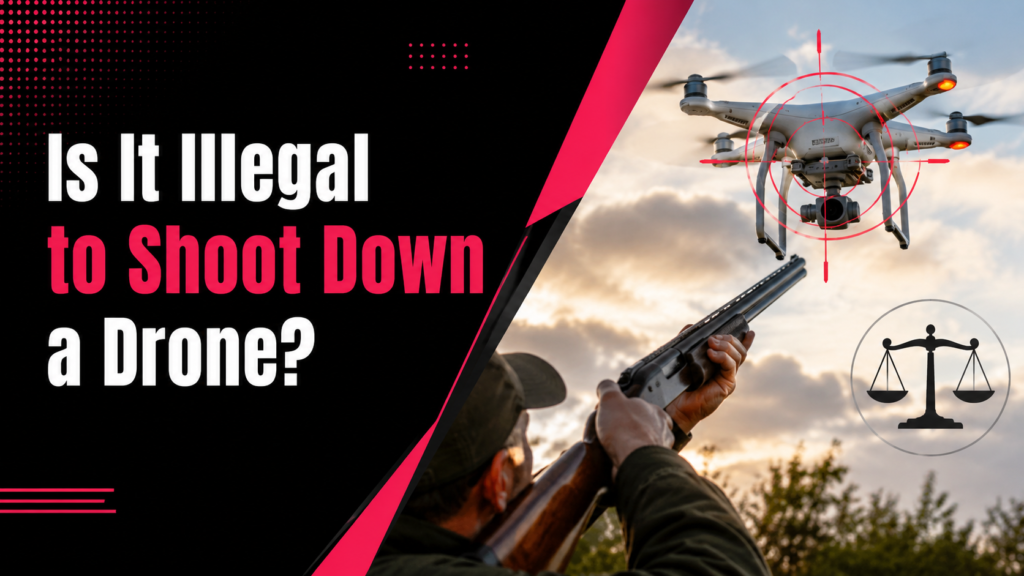

A drone hovers over your backyard at dusk. Its camera seems pointed at your windows or your kids playing. Frustration builds. You wonder if you can simply take it out of the sky. Many property owners face this exact moment, and the impulse to act feels natural.
Is it illegal to shoot down a drone? Yes. Under federal law, drones count as aircraft. Intentionally damaging or destroying one can trigger serious criminal charges, including a federal felony with penalties up to 20 years in prison. This article explains the key statutes, real cases, airspace rules, state variations, and practical steps you can take instead. It aims to give property owners, recreational pilots, and local officers clear, usable guidance.
Why Drones Count as Aircraft Under Federal Law
The Federal Aviation Administration treats unmanned aircraft systems the same as manned planes for many safety rules. Congress and the FAA define an aircraft broadly as any contrivance invented, used, or designed to navigate, fly, or travel in the air. That definition covers everything from a large commercial jet to a small recreational quadcopter.
This classification matters because federal criminal statutes protect aircraft from willful damage. The most important provision is 18 U.S.C. § 32, often called the Aircraft Sabotage Act. It makes it a crime to willfully set fire to, damage, destroy, disable, or wreck any aircraft in the special aircraft jurisdiction of the United States or any civil aircraft used in interstate, overseas, or foreign air commerce.
Courts and the FAA have applied this language to drones. Even a lightweight hobby drone falls under the statute once it is airborne. The FAA has stated publicly that shooting at any aircraft, including unmanned ones, is illegal and creates safety hazards. A falling drone or a missed shot can injure people or damage property on the ground. It can also endanger other aircraft.
The statute carries severe consequences. A conviction can mean a fine under Title 18 and imprisonment for not more than 20 years, or both. Related provisions cover attempts, conspiracies, and threats. Threatening to destroy an aircraft can itself lead to significant prison time.
Jamming a drone’s control signal or using electronic means to disable it raises additional federal problems. Those actions can implicate laws against interfering with radio communications or computer systems. Private citizens lack authority to perform counter-unmanned aircraft system operations. Only certain federal agencies hold limited statutory exemptions for protecting designated facilities.
Navigable Airspace and Private Property Rights
Property owners often assume their rights extend upward without limit. Common law once followed the maxim that ownership ran from the center of the earth to the heavens. Modern aviation changed that view.
In the 1946 Supreme Court case United States v. Causby, the Court rejected unlimited vertical ownership. It held that the air above the minimum safe altitudes of flight is a public highway. At the same time, the Court recognized that landowners retain rights in the immediate reaches of the atmosphere. Flights so low and frequent that they directly interfere with the use and enjoyment of the land can amount to a taking that requires compensation.
For drones, the practical result is layered. The FAA claims exclusive sovereignty over the navigable airspace. Most recreational and commercial small drones operate below 400 feet above ground level. That zone sits below traditional manned aircraft altitudes in many places, yet the FAA still regulates it for safety. Property rights in the immediate airspace do not authorize the use of force against aircraft.
Courts have not recognized a general self-help right to shoot down a drone simply because it flies over private land. Claims of trespass or invasion of privacy may support civil lawsuits or local criminal complaints in some states, but they do not create an exception to 18 U.S.C. § 32.
Real Cases Show the Risks
Several incidents illustrate how these rules play out.
In Kentucky in 2015, a homeowner known as the “drone slayer” used a shotgun on a neighbor’s hexacopter that he believed was hovering low and filming his daughter. Local charges of criminal mischief and wanton endangerment were dismissed by a judge who focused on privacy concerns. The drone owner then sued in federal court. The federal case was dismissed on jurisdictional grounds, but federal prosecutors and the FAA made clear that destruction of an aircraft remained a potential federal offense. The episode did not create a legal right to shoot.
In Florida, a 72-year-old man fired a handgun at a Walmart delivery drone flying near his home. He faced state charges of criminal mischief and discharging a firearm in public. He entered a pretrial intervention program that required restitution of several thousand dollars, community service, and staying out of further trouble. Federal exposure remained a background risk.
Another Florida case involved a man who shot down a sheriff’s office drone. Because he was a prohibited person in possession of a firearm, he received a multi-year federal prison sentence on related charges. In New Mexico, a man who fired at a police drone received a lengthy federal sentence after pleading guilty to attempting to damage an aircraft along with other offenses.
These examples show a consistent pattern. Local charges for reckless endangerment, criminal mischief, or illegal discharge of a firearm often appear first. Federal charges under the Aircraft Sabotage Act remain available and have been used, especially when law-enforcement drones or repeat offenders are involved. Civil liability for the destroyed equipment is common even when criminal charges are reduced or dismissed.
State Laws and Privacy Expectations
Federal law preempts state attempts to regulate airspace and aircraft operations. States cannot authorize private citizens to destroy drones. They can, however, address privacy, surveillance, and related ground-level harms.
Several states have enacted drone-specific privacy statutes. California’s Civil Code section 1708.8 covers physical invasion of privacy and can support civil damages, including statutory penalties, when a drone captures images in a place where a person has a reasonable expectation of privacy. Texas Government Code Chapter 423 restricts the use of drones to capture images of people or private property with intent to conduct surveillance. Florida’s Freedom from Unwarranted Surveillance Act limits drone recording of private property when the person is not observable from ground level. Oregon, Illinois, and others create private rights of action or criminal penalties for certain surveillance uses.
These laws can help a property owner pursue the operator after the fact. They do not authorize shooting the aircraft. Local ordinances sometimes restrict launch and recovery on public land or impose noise and time-of-day limits, but they cannot override federal aircraft protections.
Local law enforcement jurisdiction typically covers immediate threats, trespass complaints, and state privacy violations. Officers can respond, identify the operator if possible, and refer aviation rule violations to the FAA. They generally lack authority to disable a drone themselves unless a specific federal exemption applies.
Safety Hazards Beyond the Criminal Statutes
Even setting aside 18 U.S.C. § 32, shooting at a drone creates practical dangers. Bullets that miss continue traveling and can strike people or property far away. A damaged drone can fall in an uncontrolled path, striking bystanders, vehicles, or structures. In urban or suburban settings the risk multiplies.
Reckless endangerment statutes in most states cover the act of discharging a firearm in a manner that creates substantial risk of serious physical injury. Destruction of personal property claims can follow from the drone owner. Homeowners insurance may refuse coverage if the policyholder intentionally damaged someone else’s property.
For recreational drone pilots, the reverse is also true. Operating in a way that endangers people or property violates FAA rules and can support state charges. Keeping the aircraft within visual line of sight, below 400 feet in most cases, and clear of people remains the baseline expectation.
Lawful Alternatives for Addressing Nuisance or Privacy Concerns
Taking the law into your own hands is never the recommended path. Several practical steps exist.
First, document the activity. Note the date, time, approximate altitude, direction of flight, and any visible markings or lights. Capture video or photographs from a safe position if possible. If the drone broadcasts Remote ID information, record that data. Do not confront the operator in a way that escalates the situation.
Second, contact local law enforcement if the flight appears unsafe or is being used to commit a crime. Police can respond in real time, check for operator location, and address any immediate public-safety issues. Provide them with the documentation you collected.
Third, report potential FAA rule violations to the appropriate Flight Standards District Office. The FAA investigates unsafe operations and can impose civil penalties or certificate actions. Reports are more useful when they include specific facts rather than general complaints.
Fourth, consider civil remedies. In states with strong privacy statutes, a lawsuit for invasion of privacy, trespass, or nuisance may be available. Some statutes provide statutory damages. Consult a local attorney familiar with aviation and privacy law before filing. Small-claims court can sometimes resolve damage claims for a destroyed drone if the roles were reversed, but the same process can work for repeated low flights that interfere with property use.
Fifth, for recurring problems, explore neighborhood or homeowners-association rules, local noise ordinances, or requests for Temporary Flight Restrictions in truly exceptional circumstances. Most everyday privacy complaints will not qualify for federal airspace restrictions.
Signal jammers and other electronic countermeasures remain illegal for private use. They interfere with licensed radio spectrum and can disrupt legitimate communications, including emergency services.
Practical Guidance for Different Audiences
Property owners should treat a hovering drone as a potential privacy or safety concern rather than an invitation to use force. Document, report, and pursue legal channels. Keep firearms out of the equation unless a genuine, imminent threat to life exists under traditional self-defense standards. A camera-equipped drone rarely meets that threshold.
Recreational drone pilots can reduce conflict by following FAA rules strictly, avoiding prolonged low flights over private yards, and respecting reasonable privacy expectations even when no specific statute applies. Register the aircraft when required, display the registration number, and maintain visual line of sight.
Local law enforcement officers benefit from clear protocols. Respond to public-safety calls first. Identify the operator when feasible. Refer aviation safety issues to the FAA through established channels such as the Law Enforcement Assistance Program. Avoid any attempt to disable the aircraft unless authorized under a specific federal C-UAS statute.
Legal enthusiasts will note that the current framework prioritizes aviation safety and federal preemption over expansive private self-help rights. Future legislation may expand limited C-UAS authorities for certain critical infrastructure or law-enforcement missions, but private citizens are unlikely to receive broad permission to destroy aircraft.
Common Pitfalls to Avoid
Do not assume that “it was over my property” creates a defense. Courts have rejected that argument under the federal aircraft statute. Do not rely on outdated common-law maxims about air rights. Do not use electronic jamming devices. Do not escalate by confronting the operator in a hostile manner. Do not ignore the possibility of civil liability even if criminal charges are not filed.
Keep expectations realistic. FAA investigations take time. Privacy statutes vary widely by state. Not every low flight constitutes a legal violation. Persistent, targeted surveillance of private spaces is more likely to support a claim than a brief overflight.
Conclusion
Federal law treats drones as aircraft. Shooting one down violates 18 U.S.C. § 32 and can lead to felony charges, large fines, and prison time. Property rights in the immediate airspace do not authorize the destruction of aircraft. State privacy laws offer civil and sometimes criminal remedies against operators, but they do not create an exception for self-help force.
Document the incident, contact local law enforcement for immediate safety issues, report aviation violations to the FAA, and consider civil options under applicable state statutes. These steps protect both personal privacy and public safety without exposing the property owner to severe federal liability.
If you face repeated drone activity that interferes with your property or privacy, consult a qualified attorney familiar with aviation and local privacy law. Understanding the rules in advance is the surest way to protect your rights without creating new legal problems.
Frequently Asked Questions
Is it illegal to shoot down a drone on your property?
Yes. Federal law prohibits willfully damaging or destroying any aircraft, and the FAA classifies drones as aircraft. The location over private property does not create an exception.
What are the federal penalties for shooting down a drone?
Under 18 U.S.C. § 32, a conviction can result in a fine and imprisonment for up to 20 years. State charges for reckless endangerment, criminal mischief, or illegal firearm discharge often accompany the federal risk.
Can you shoot a drone hovering over your yard?
No. Doing so remains a federal crime regardless of altitude or perceived privacy invasion. Document the flight and contact authorities instead.
What happens if you shoot down a drone?
You may face arrest, state criminal charges, federal investigation, civil lawsuits for the value of the aircraft, and possible FAA civil penalties. Real cases have produced restitution orders, community service, and prison sentences in more serious circumstances.
Are there legal consequences of shooting a private drone?
Yes. Consequences include potential felony conviction, loss of firearm rights, civil damages, and insurance complications. Even if federal charges are not filed, state liability remains.
How should you handle a nuisance drone legally?
Document time, location, altitude, and any identifying information. Call local law enforcement if safety is at risk. Report FAA rule violations to the local Flight Standards District Office. Explore state privacy statutes for civil claims. Avoid any attempt to disable the aircraft yourself.
Does the FAA regulate privacy?
No. The FAA focuses on safety and airspace. Privacy issues fall under state law and local ordinances. Many states now have specific drone-surveillance statutes that can support complaints or lawsuits.
You May Also Like: What’s the Difference Between DUI and DWI? Key Legal Differences Explained