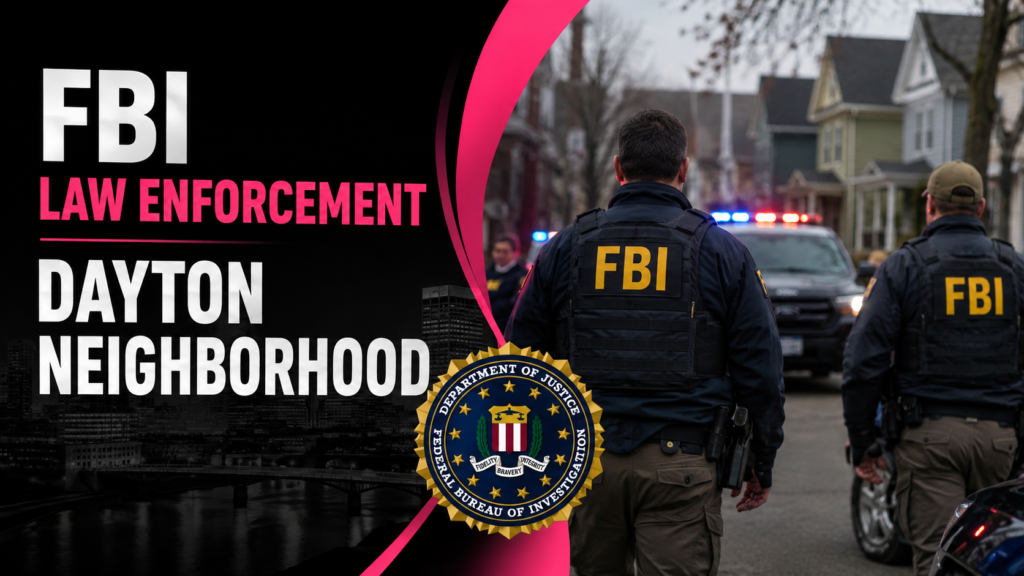

Residents across Dayton and Montgomery County have noticed increased federal and local law enforcement presence in neighborhoods at various points in recent years. Unmarked vehicles, tactical gear, and temporary street closures can raise immediate questions about safety and what is happening nearby. Understanding these responses helps separate verified information from rumor.
This article provides a clear overview of documented FBI law enforcement Dayton neighborhood activity, the role of partner agencies such as the Montgomery County Sheriff’s Office, and practical steps for residents during active operations. It draws on public statements from officials and established procedures for court-authorized activity. The goal is to give local residents, news followers, and community safety advocates reliable context so they can stay informed and respond appropriately.
Recent FBI and Multi-Agency Activity in Dayton Area Neighborhoods
Federal agents from the FBI’s Cincinnati Field Office have conducted multiple operations in Dayton and surrounding communities. In early July 2025, confirmed activity occurred at several locations. On July 2, agents and partners operated in the 1100 block of Graystone Drive in Trotwood. On July 7, similar court-authorized activity took place in the 400 block of Ostrander Drive in the Eastern Hills neighborhood and later in the 4500 block of Sylvan Drive.
FBI spokesperson Todd Lindgren confirmed these were part of ongoing investigations. Agents remained on scene for hours in some cases. Neighbors reported seeing tactical vehicles and personnel securing perimeters. No public evacuations or broad safety threats were announced for the surrounding areas. Officials consistently described the work as court-authorized law enforcement activity, a phrase that signals legal authority while limiting release of investigative details.
Similar patterns appeared in other periods. In December 2025, activity was reported in the 4200 block of Willow Hills Drive related to a racketeering investigation that led to arrests. Earlier and later narcotics and firearms operations have also involved FBI Safe Streets Task Force members working alongside local partners.
A larger coordinated effort, known as Operation Fly City, ran for eight weeks from late April into mid-June 2026. Led primarily by the Bureau of Alcohol, Tobacco, Firearms and Explosives with strong support from Homeland Security Investigations, the Dayton Police Department, the Montgomery County Sheriff’s Office, and other agencies, it targeted gun violence and drug trafficking. Authorities announced 47 individuals charged, 43 taken into federal custody at the time of the announcement, and the seizure of 176 firearms (including machine guns and conversion devices) plus kilogram quantities of fentanyl, cocaine, and methamphetamine. U.S. Attorney Dominick S. Gerace II and local chiefs highlighted the focus on repeat violent offenders.
These examples illustrate how federal investigation work often intersects with local law enforcement response in Dayton neighborhoods. Many operations remain quiet by design until charges or major seizures are ready for public announcement.
What “Court-Authorized Law Enforcement Activity” Means
When the FBI or partners use this language, it typically refers to the execution of a search warrant, arrest warrant, or related court order approved by a federal magistrate or judge. Agents must present probable cause to a neutral judicial officer before entering private property or taking certain actions. The phrase protects the integrity of the investigation by avoiding premature disclosure of targets, evidence, or methods.
In practice, this can look like early-morning entries, evidence collection lasting several hours, or the temporary securing of a block. Local agencies such as the Dayton Police Department or Montgomery County Sheriff’s Office frequently provide perimeter support, traffic control, or additional personnel. The presence of multiple agencies does not automatically signal a widespread public threat. Most confirmed Dayton-area operations of this type in 2025 and 2026 targeted specific addresses rather than entire neighborhoods.
How Federal and Local Agencies Coordinate in Montgomery County
Effective responses rely on established partnerships. The FBI Cincinnati Field Office covers central and southern Ohio, including Montgomery County. It routinely works through task forces such as the Safe Streets Task Force. Local counterparts include the Dayton Police Department, the Montgomery County Sheriff’s Office, and specialized units like the RANGE (Regional Agencies Narcotics & Gun Enforcement) Task Force.
These partnerships share intelligence, combine resources, and divide operational roles. Federal agents may lead the core investigative work and evidence handling. Local officers handle outer security, community notifications when needed, and any state-level charges that arise. In Operation Fly City, for example, ATF and HSI provided key leadership while Dayton Police and the Sheriff’s Office contributed street-level knowledge and manpower.
This model appears in narcotics warrants, firearms trafficking cases, and other violent crime efforts. Public statements from Sheriff Rob Streck’s office and Dayton Police leadership have repeatedly stressed that joint work removes guns and drugs from streets and holds habitual offenders accountable. Residents benefit when agencies avoid duplication and move faster on threats that cross jurisdictional lines.
Typical Sequence of a Neighborhood Operation
Most court-authorized activities follow a predictable sequence once the decision to move is made:
- Pre-operation planning and judicial approval of warrants.
- Deployment of agents and local support, often in the early morning for tactical advantage and reduced bystander risk.
- Securing the immediate area and any vehicles or persons of interest.
- Search, evidence collection, or arrests as authorized.
- Processing of any seized items and individuals.
- Gradual release of the scene once the immediate work is complete.
During this time, unmarked cars, marked units, and sometimes specialized equipment (robots, bomb squad elements in rare cases) may be visible. Residents outside the perimeter usually experience only temporary inconvenience such as delayed traffic or restricted access to a short stretch of roadway.
Public Safety Impacts and What Residents Experience
Most documented FBI law enforcement Dayton neighborhood responses have not required neighborhood-wide evacuations. Officials have stated there was no current threat to the broader public in the July 2025 cases and similar operations. The focus remains on specific individuals or properties connected to the investigation.
That said, the sudden appearance of tactical teams can feel alarming. Neighbors have described waking to loud announcements, the sound of forced entry tools, or the sight of agents in protective gear. Children, elderly residents, and those with mobility challenges may feel particular stress. Pet owners sometimes worry about animals left outside or near the scene.
From a community safety perspective, these operations often aim to reduce longer-term risks. Seizing illegal firearms and removing sources of fentanyl or other drugs can lower the chance of future shootings or overdoses in the same areas. Data shared during the Operation Fly City announcement noted elevated levels of gun violence and drug activity that justified the concentrated effort.
Is the Neighborhood Safe During and After Activity?
In the confirmed cases reviewed, residents were not ordered to leave their homes, and no general public safety alerts for chemical, explosive, or ongoing shooter threats were issued. Once the primary work ends, the scene is usually cleared and normal access restored. Any remaining investigation continues behind the scenes through interviews, forensic analysis, and grand jury processes.
If a genuine emergency develops (for example, an unexpected confrontation), local emergency response protocols activate. Dayton Police or Montgomery County Regional Dispatch would issue specific instructions through official channels, media partners, or reverse 911 systems when needed.
How Residents Should Respond During Active Operations
Clear, simple actions protect both residents and officers.
Stay inside if you are in or near the secured area unless directed otherwise by uniformed personnel. Approaching the perimeter, filming aggressively from close range, or attempting to enter a blocked street can create confusion and risk. Agents focused on an active warrant may not immediately distinguish curious neighbors from potential threats.
Follow any verbal directions from officers on the scene. If a street is closed, use alternate routes. Keep children and pets indoors. Avoid sharing unverified rumors on social media that could interfere with the operation or spread unnecessary fear.
If you have relevant information about the specific address or individuals, contact authorities through official tip lines rather than approaching agents on site. The FBI accepts tips at tips.fbi.gov or by phone through the Cincinnati Field Office. Local Crime Stoppers or non-emergency police numbers also work for community tips.
After the activity ends, normal routines typically resume quickly. If property damage occurred on a neighboring lot (rare but possible with forced entry at the target location), contact the responsible agency for information on any follow-up processes.
Practical Safety Checklist for Dayton Residents
- Monitor official sources: Dayton Police Department social media, Montgomery County Sheriff’s Office updates, and local news outlets that verify with spokespersons.
- Sign up for emergency alerts through local government systems if available.
- Know the difference between a neighborhood operation and a true active threat requiring shelter-in-place.
- Keep basic emergency supplies accessible and have a family communication plan.
- Report suspicious activity in your own neighborhood through established tip channels before it escalates.
These steps form core community safety protocols that apply whether the presence involves FBI agents, local SWAT, or a joint task force.
Understanding Broader Context: Violent Crime and Federal Priorities
Dayton and Montgomery County have faced persistent challenges with gun violence and the opioid and fentanyl crisis. Officials have cited numbers of shootings and homicides that remain higher than desired for a community of this size. Federal resources are often directed toward the most violent or prolific offenders precisely because local capacity alone cannot address every case involving interstate elements, complex trafficking networks, or specialized evidence.
Task forces allow agencies to pool tools such as federal grand juries, longer potential sentences for certain firearms and drug offenses, and technical capabilities. The result is not constant federal presence on every block. Instead, targeted, intelligence-driven operations appear when evidence supports them. Residents who see activity should view it as one piece of a larger public safety strategy rather than a sudden crisis.
Legal precedents and statutes governing these actions include the Fourth Amendment requirements for warrants, the federal rules of criminal procedure, and specific statutes covering firearms trafficking, controlled substances, and racketeering. Courts review the basis for warrants; defendants retain the right to challenge evidence and procedures later in the judicial process.
Staying Informed Through Verified Channels
Reliable information comes from primary sources. The FBI Cincinnati Field Office issues statements through its public affairs specialists. The U.S. Attorney’s Office for the Southern District of Ohio announces major charging decisions and operation results. Local departments post updates on their websites and verified social accounts. Major local news organizations typically seek confirmation from these same spokespersons before reporting details.
Avoid relying solely on unverified social media posts or secondhand accounts of what agents “must be” investigating. Details of ongoing federal investigations are restricted by policy and law for good reason: protecting witnesses, preserving evidence, and ensuring fair proceedings.
For broader crime trends or prevention resources, the Montgomery County Sheriff’s Office and Dayton Police Department publish regular public safety information. Community meetings and National Night Out-style events also provide opportunities to hear directly from local leadership.
Conclusion
FBI law enforcement Dayton neighborhood activity, whether a single warrant service or part of a larger initiative like Operation Fly City, follows established legal processes and typically targets specific threats rather than entire communities. Coordination with the Montgomery County Sheriff’s Office, Dayton Police, and other partners strengthens the response while aiming to improve long-term safety. Residents protect themselves best by staying clear of active scenes, following official instructions, and seeking verified updates.
If you observe activity near your home, remain calm, stay indoors when appropriate, and rely on official channels for information. For tips related to ongoing investigations or community concerns, use established reporting methods. Staying informed and prepared helps everyone contribute to safer neighborhoods across Dayton and Montgomery County.
Frequently Asked Questions
What does “court-authorized law enforcement activity” mean when the FBI is in a Dayton neighborhood?
It means agents are executing a search warrant, arrest warrant, or similar order approved by a judge based on probable cause. Details of the specific investigation are usually withheld while the case remains active.
Why is the FBI involved instead of just local police?
Federal agencies join when the case involves potential federal crimes (firearms trafficking, certain drug conspiracies, racketeering, or interstate elements) or when specialized resources are needed. Local partners still play major support roles.
Is my neighborhood unsafe if FBI agents appear on my street?
In the documented 2025 and 2026 cases, officials did not announce general public safety threats or require evacuations of surrounding homes. Operations focus on specific locations. Follow any direct instructions from officers on scene.
What should I do if I see FBI or SWAT activity near my home?
Stay inside, keep a safe distance from any perimeter, avoid interfering, and wait for official updates. Do not approach agents or try to film from within a secured area.
How can I get accurate information about current police activity in Dayton?
Check verified accounts and websites of the Dayton Police Department, Montgomery County Sheriff’s Office, FBI Cincinnati Field Office, and established local news outlets that confirm statements with official spokespersons.
Are arrests always announced right after an FBI operation?
No. Evidence is reviewed, and charges may be filed later, sometimes under seal. Public announcements often come only after indictments or major seizures.
Who should I contact if I have information related to an investigation?
Submit tips to tips.fbi.gov, the FBI Cincinnati Field Office, local Crime Stoppers, or the non-emergency number for Dayton Police or the Montgomery County Sheriff’s Office.
You May Also Like: Mann Act Transportation: Key Legal Elements and History