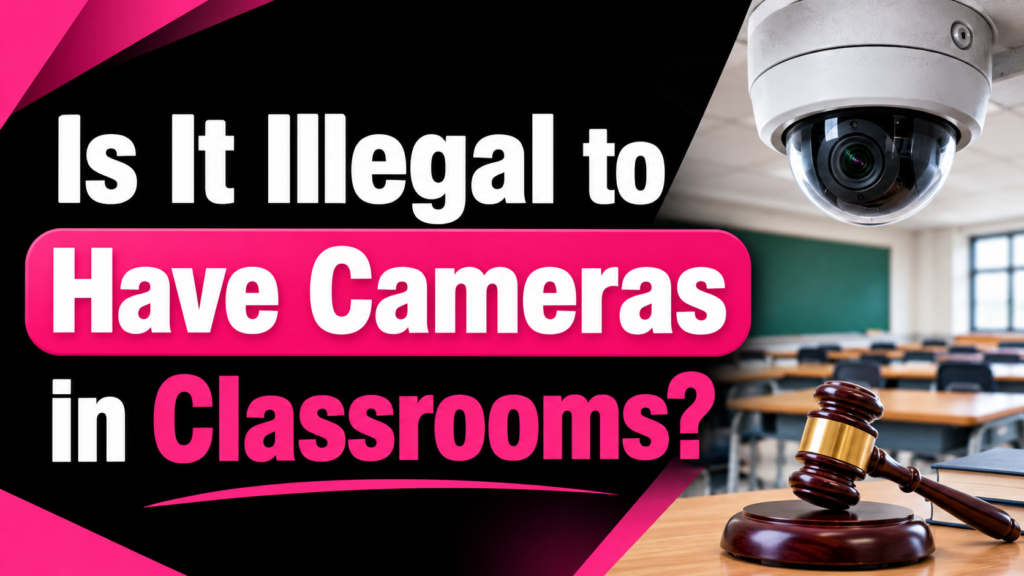

Imagine a principal reviewing hallway footage after a fight, or a parent asking whether classroom cameras protect their child or invade privacy. School security systems are now common, yet questions about classroom cameras keep rising. Administrators, teachers, parents, and board members all want clear answers.
This guide explains when classroom cameras are legal, how FERPA compliance works, what student privacy rights require, and how state wiretapping and audio recording laws change the picture. You will find practical criteria for visible security cameras, data retention, and administrative access controls so schools can improve safety without losing trust.
The Short Answer: Cameras Are Not Automatically Illegal
No federal law bans video cameras in U.S. public school classrooms. Most states allow them when schools follow notice rules, avoid private spaces, and handle footage correctly. The legality depends on three main factors: whether the camera records audio, whether people receive notice, and whether state statutes or district policies add extra limits.
Courts treat classrooms as shared educational spaces with a reduced reasonable expectation of privacy. Students and staff already share the room with many other people. Recording what is already visible generally does not violate constitutional privacy rights the way a camera in a restroom would.
That does not mean anything goes. Schools still face real constraints under the Family Educational Rights and Privacy Act (FERPA), state consent rules for audio, labor agreements with teachers, and local board policies. Hidden cameras, continuous audio without consent, or placement in bathrooms and locker rooms cross clear legal lines.
Federal Law and FERPA Compliance
FERPA protects the privacy of student education records. It does not prohibit cameras. It regulates what happens after the camera records something that identifies a student.
According to official U.S. Department of Education guidance, a photo or video becomes an education record when two conditions are met: it is directly related to a student, and the school (or someone acting for the school) maintains it.
Factors that point toward “directly related” include:
- The school uses the footage for discipline or another official purpose involving the student.
- The video shows a student violating rules or law, getting injured, or experiencing a health emergency.
- The recording focuses on a specific student rather than capturing people only in the background.
A hallway camera that happens to catch dozens of students walking to class is not automatically an education record for every person who appears. The same footage becomes an education record for the students involved once the school pulls it for a fight investigation or disciplinary decision.
Law Enforcement Unit Exception
FERPA contains an important exclusion. Records created and maintained by a school’s law enforcement unit solely for a law enforcement purpose are not education records. Many districts designate their security office or school resource officers as a law enforcement unit. Footage kept only in that unit for security purposes often falls outside FERPA.
The moment the security office shares a copy with administrators for student discipline, that copy can become an education record subject to FERPA rules.
Parents (or eligible students age 18 and older) have the right to inspect and review education records. Schools must redact or segregate information about other students when they can do so without destroying the meaning of the record. If redaction is not reasonably possible, parents still get to view the relevant portion.
Schools are not always required to give parents a personal copy. Inspection is the core right. Districts should have clear procedures for logging requests, verifying identity, and deciding whether redaction is feasible.
Reasonable Expectation of Privacy in Schools
The Fourth Amendment applies in public schools, but students have diminished privacy expectations compared with adults outside school. The Supreme Court made this clear in New Jersey v. T.L.O. (1985). School officials do not need warrants or probable cause for many searches; reasonable suspicion is enough.
Courts extend similar reasoning to video surveillance. Cameras in hallways, cafeterias, entrances, parking lots, and buses rarely raise constitutional problems because those areas are open and people already expect to be seen.
Classrooms sit in a middle zone. They are not fully private, yet the teaching and learning interactions feel more personal than a hallway conversation. Most courts still uphold video-only cameras in classrooms when the school has a legitimate safety purpose and the cameras are not used for constant close-up monitoring of individuals.
The hard prohibition covers places where people undress or expect seclusion: restrooms, locker rooms, and changing areas. Federal courts have struck down cameras in school locker rooms because students retain a privacy interest in their bodies. No safety rationale overcomes that limit.
Audio Recording and Wiretapping Laws
Video-only recording is far simpler than recording sound. The moment a camera captures audio, state wiretapping and audio recording laws apply.
Federal law follows a one-party consent rule. If one person in the conversation consents, the recording is generally legal under federal rules. Roughly a dozen states impose stricter all-party (or two-party) consent requirements. In those states, every person whose voice is recorded must agree beforehand, or the recording can be a crime.
States commonly listed as all-party consent include California, Connecticut, Florida, Illinois, Maryland, Massachusetts, Montana, New Hampshire, Pennsylvania, and Washington (lists vary slightly by source and exact application). Schools in these states almost always disable microphones on classroom cameras to avoid criminal liability and civil claims.
Even in one-party consent states, best practice is to turn audio off unless the school has clear written policy, notice, and a specific educational or safety justification. Classroom conversations can feel private enough that some courts treat them as protected oral communications.
Teachers who want to record their own lessons for professional growth or student feedback must check district policy and state law first. Personal recordings that capture identifiable students create education records outside the school’s controlled systems and can violate FERPA and local rules.
Special Education Classroom Cameras
Several states have enacted specific laws for self-contained special education classrooms. These rooms often serve students with significant communication challenges who may not be able to report abuse or neglect themselves.
Texas was an early adopter. Its law requires districts to install video (and often audio) cameras in special education settings upon written request from a parent, staff member, or administrator. Recordings must be retained for a minimum period (commonly three months) and may be used only for safety or incident review, not teacher evaluation.
Louisiana expanded its rules and now requires continuous audio and video recording in covered self-contained special education classrooms, with notice signage and limited access. Alabama, West Virginia, and Georgia have related statutes or options. Other states continue to debate similar bills.
These laws typically include strong privacy safeguards: limited access, retention minimums, prohibition on using footage for routine teacher evaluation, and rules against cameras in bathrooms or changing areas attached to the classroom. Parents and advocates often support the cameras for accountability. Some educators raise concerns about constant surveillance and its effect on the learning environment.
Districts in states without specific statutes still may install cameras in special education rooms under general authority, but they should involve legal counsel, special education staff, and parents early.
Visible Cameras, Notice, and Hidden Surveillance
Visible security cameras reduce legal risk and build trust. Most best-practice guidance recommends clear placement and notice through handbook language, entrance signs, or classroom postings. Notice eliminates arguments that someone expected privacy in a monitored space and serves as a deterrent.
Hidden cameras face much higher scrutiny. Several states restrict or ban concealed recording devices. Even where not expressly illegal, secret classroom cameras can violate district policy, collective bargaining agreements, and expectations of transparency. Covert cameras for a narrow, time-limited investigation of specific misconduct may be defensible in limited circumstances after legal review. Blanket hidden surveillance is not.
Teachers who install personal cameras without written administrative approval almost always step outside policy. The recording then sits outside the district’s security and FERPA controls, creating liability for the teacher and the school.
Video Footage Retention and Access Controls
Retention periods vary. Many districts keep ordinary security footage 30 to 90 days. Special education camera laws often set longer minimums (one month, three months, or more). Footage tied to an active investigation or legal hold must be preserved longer.
Strong administrative access controls matter. Limit viewing rights to designated security staff, administrators, and (when needed) law enforcement. Log every access. Prohibit routine browsing. Train staff that curiosity is not a legitimate purpose.
When parents request footage under FERPA, the school must determine whether the video is an education record, whether other students appear, and whether redaction is feasible. Responding carefully protects both the requesting family and the privacy of other students.
Practical Guidelines for Compliant Camera Deployment
Schools that want to use classroom cameras should follow a clear process:
- Check state statutes, board policy, and any collective bargaining agreements that address surveillance.
- Decide whether audio will be enabled. In most cases, leave it off.
- Place cameras only in areas without a high expectation of privacy. Avoid restrooms, locker rooms, and private offices.
- Make cameras visible and provide notice to parents, students, and staff.
- Write a written school surveillance policy that covers placement, purpose, retention, access, redaction, and request procedures.
- Designate a law enforcement unit if the district wants to keep pure security footage outside FERPA.
- Train staff on access limits and FERPA obligations.
- Review the system periodically for both effectiveness and privacy compliance.
These steps help schools maintain campus safety regulations while respecting student privacy rights.
Common Pitfalls to Avoid
- Enabling audio without checking state consent rules.
- Failing to notify families and staff.
- Using classroom footage for routine teacher evaluation when policy or contracts prohibit it.
- Storing footage indefinitely without a retention schedule.
- Allowing broad staff access without logging.
- Ignoring special education specific statutes in states that have them.
- Assuming every video request must be answered the same way. Context always matters under FERPA.
Conclusion
Classroom cameras are not illegal under federal law, and most states permit them when schools respect privacy boundaries, give notice, and handle footage carefully. The real work lies in FERPA compliance, state audio consent rules, visible placement, limited access, and clear retention practices.
Schools that treat cameras as one tool among many, rather than a complete security solution, tend to maintain both safety and community trust. Parents who understand the rules can ask better questions and advocate effectively for their children.
Review your district’s current surveillance policy, consult legal counsel familiar with your state’s education and recording laws, and update procedures as needed. Clear rules protect students, staff, and the institution itself.
Frequently Asked Questions
Is it illegal to have cameras in classrooms with audio?
It depends on the state. In all-party consent states, recording audio without consent from everyone whose voice is captured can violate wiretapping laws. Most schools disable audio on classroom cameras for this reason.
Are security cameras allowed in public school classrooms?
Yes, in the large majority of states, provided the cameras are video-only (or properly consented for audio), placed where there is no high expectation of privacy, and operated under clear policies.
When is school surveillance illegal in the US?
Surveillance becomes illegal when cameras enter restrooms or locker rooms, when hidden cameras are used without legal justification, when audio is recorded in violation of state consent laws, or when footage is mishandled in ways that violate FERPA.
Can parents request school security camera footage under FERPA?
Yes, when the footage is an education record (directly related to the student and maintained by the school). Parents have the right to inspect and review. Schools may redact other students when possible.
Do schools have to notify parents about classroom cameras?
Many states and best-practice policies require or strongly recommend notice. Visible cameras plus handbook language or signage reduce legal and trust problems.
Are hidden cameras illegal in schools?
Often yes, or at least highly restricted. Concealment can violate state laws against secret recording and almost always conflicts with transparency expectations and district policy.
What about cameras in special education classrooms?
Several states require or allow them upon request or by mandate, with specific retention, access, and use limits designed to protect vulnerable students.
You May Also Like: Is It Illegal to Shoot Down a Drone? Federal Laws Explained