
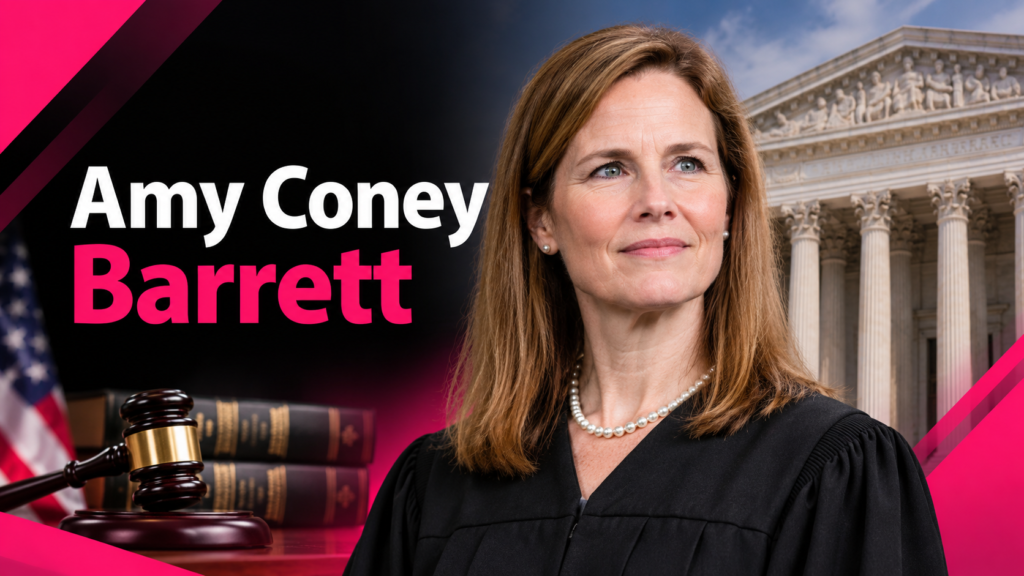

Amy Coney Barrett is an Associate Justice of the Supreme Court of the United States, serving since October 27, 2020. Nominated by President Donald J. Trump to fill the seat left vacant by the death of Justice Ruth Bader Ginsburg, she is the fifth woman to serve on the nation’s highest court. Born Amy Vivian Coney in New Orleans, Louisiana, on January 28, 1972, Barrett rose through distinguished academic achievement, elite clerkships, private practice, a long career as a law professor, and service on the U.S. Court of Appeals for the Seventh Circuit before joining the Supreme Court. Her judicial philosophy centers on originalism and textualism, approaches closely associated with her former boss, Justice Antonin Scalia. People search for her name to understand her background, legal reasoning, confirmation process, and role in major constitutional decisions.
Amy Coney Barrett: Quick Profile
| Detail | Information |
|---|---|
| Full Name | Amy Vivian Coney Barrett (née Coney) |
| Profession | Associate Justice, Supreme Court of the United States |
| Legal Role | Federal appellate judge (2017–2020); Supreme Court Justice (2020–present) |
| Law Firm | Previously Miller, Cassidy, Larroca & Lewin (later Baker Botts); now judicial office |
| Practice Areas | Constitutional law, statutory interpretation, federal courts (as professor and judge) |
| Location | Washington, D.C. (Supreme Court); previously South Bend, Indiana area |
| Education | B.A., Rhodes College (1994); J.D., Notre Dame Law School (1997) |
| Bar Admission | Virginia (2000); District of Columbia (2001) |
| Known For | Originalism and textualism; clerkship with Justice Scalia; confirmation to replace Justice Ginsburg |
Who Is Amy Coney Barrett?
Amy Coney Barrett is one of nine justices on the Supreme Court of the United States. She occupies the seat once held by Justice Ruth Bader Ginsburg and is currently the circuit justice for the Seventh Circuit. Before reaching the high court, she spent three years as a judge on the U.S. Court of Appeals for the Seventh Circuit, which hears cases from Illinois, Indiana, and Wisconsin. Prior to that appointment she was a tenured professor at Notre Dame Law School, where she taught constitutional law, federal courts, and statutory interpretation for fifteen years.
Her professional significance stems from both her rapid ascent and the interpretive methods she brings to the bench. Barrett is widely described as an originalist and textualist. These approaches emphasize interpreting the Constitution and statutes according to their original public meaning or ordinary meaning at the time of enactment rather than evolving social norms or policy preferences. Her clerkship with Justice Antonin Scalia in the late 1990s shaped this orientation and remains a defining feature of her public profile.
Search interest in Barrett surged during her 2020 confirmation hearings and has continued because of her participation in high-profile cases involving abortion, gun rights, administrative law, and executive power. Readers look her up to learn her educational credentials, career path, judicial philosophy, and the controversies that surrounded her nomination so close to a presidential election.
Amy Coney Barrett’s Legal Career
Barrett’s legal career follows a classic elite trajectory that combined academic excellence, prestigious clerkships, brief private practice, teaching, and then federal judicial service.
After graduating first in her class from Notre Dame Law School in 1997, she clerked for Judge Laurence H. Silberman on the U.S. Court of Appeals for the D.C. Circuit during the 1997–1998 term. The following year she moved to the Supreme Court as a clerk for Justice Antonin Scalia. Those two clerkships placed her at the center of conservative legal thought and exposed her to the rigorous, text-focused method Scalia championed.
From 1999 to roughly 2001 or 2002 she practiced at the Washington, D.C., litigation boutique Miller, Cassidy, Larroca & Lewin, which later merged into Baker Botts. During that period she worked on the firm’s representation of George W. Bush in the litigation surrounding the 2000 presidential election, including research and briefing related to Bush v. Gore.
In 2001–2002 she held a fellowship and adjunct position at George Washington University Law School. In 2002 she returned to Notre Dame Law School as an assistant professor. She was later promoted to full professor and, from 2014 to 2017, held the Diane and M.O. Miller Research Chair of Law. Students repeatedly voted her Distinguished Professor of the Year. She continued teaching civil procedure, constitutional law, and statutory interpretation even after joining the federal bench.
President Trump nominated Barrett to the Seventh Circuit on May 8, 2017, to fill the seat of Judge John Tinder. The Senate confirmed her on October 31, 2017, by a 55–43 vote, and she received her commission on November 2, 2017. During her three years on that court she authored or joined approximately one hundred opinions covering criminal law, immigration, employment discrimination, Second Amendment issues, and procedural questions. She also continued teaching at Notre Dame on a part-time basis.
On September 26, 2020, following the death of Justice Ginsburg, President Trump nominated Barrett to the Supreme Court. After four days of Senate Judiciary Committee hearings, the full Senate confirmed her on October 26, 2020, by a 52–48 vote. She took the constitutional and judicial oaths and assumed her seat the next day. She has served continuously since that date.
Education and Qualifications
Barrett’s academic record is among the strongest of any modern Supreme Court justice. She attended St. Mary’s Dominican High School in New Orleans, an all-girls Catholic school, where she served as class vice president. She then enrolled at Rhodes College in Memphis, Tennessee, earning a Bachelor of Arts in English literature in 1994. She graduated magna cum laude, was elected to Phi Beta Kappa, and received recognition as the top English major and author of the outstanding senior thesis.
She entered Notre Dame Law School on a full-tuition scholarship. There she served as executive editor of the Notre Dame Law Review, graduated summa cum laude in 1997, ranked first in her class, and received the Hoynes Prize, the law school’s highest honor for scholarship, application, deportment, and achievement. She also earned awards for the best examination performance in ten different courses.
Bar admissions, according to her Senate questionnaire submitted during the Seventh Circuit confirmation process, include Virginia in 2000 and the District of Columbia in 2001. She maintained associate-member status in Virginia after beginning her teaching career. She is an elected member of the American Law Institute and has been associated with the Federalist Society.
What Type of Law Does Amy Coney Barrett Practice?
As a Supreme Court Justice, Barrett does not “practice” law in the conventional sense of representing clients. Her work consists of deciding cases that reach the Court through petitions for certiorari, writing majority, concurring, or dissenting opinions, and participating in the Court’s conference and oral arguments.
During her years as a law professor her scholarly focus was constitutional law, federal courts, and statutory interpretation. On the Seventh Circuit she encountered a broad docket typical of a federal appellate court: criminal appeals, civil rights claims, immigration matters, employment disputes, and regulatory challenges. Notable among her opinions was her dissent in Kanter v. Barr (2019), in which she argued that a nonviolent felony conviction for mail fraud should not automatically strip an individual of Second Amendment rights. She emphasized historical evidence that founding-era legislatures disarmed dangerous persons rather than all felons as a class.
On the Supreme Court her opinions have addressed a wide range of subjects, including administrative law, criminal procedure, bankruptcy, and election-related disputes. She has described herself as bound by the text of the Constitution and statutes rather than personal policy preferences. In public remarks she has rejected the label “conservative justice” in favor of “originalist,” stressing that change in constitutional meaning should occur through the amendment process or democratic legislation rather than judicial updating.
Amy Coney Barrett and Their Law Firm
Barrett’s private-practice experience was limited to approximately two years at Miller, Cassidy, Larroca & Lewin in Washington, D.C. The firm specialized in high-stakes litigation and later merged into the larger Texas-based firm Baker Botts. Her work there included assistance on the Bush v. Gore litigation. After leaving private practice she never returned to firm life; her subsequent career was academic and judicial.
As a Supreme Court Justice she has no law-firm affiliation. Her professional base is the Supreme Court of the United States in Washington, D.C. Before her elevation she lived and worked in the South Bend, Indiana, area while teaching at Notre Dame.
Notable Cases and Legal Work
On the Seventh Circuit, Barrett’s most frequently cited opinion is her dissent in Kanter v. Barr. Rickey Kanter, convicted of nonviolent mail fraud involving Medicare-related shoe inserts, challenged federal and Wisconsin laws that permanently barred him from possessing firearms. The panel majority upheld the restrictions. Barrett dissented, writing that historical evidence supported disarming dangerous individuals but not nonviolent felons simply because of their status. She argued that treating the Second Amendment as a “second-class right” was inconsistent with the Court’s precedents.
She also wrote or joined opinions involving immigration (including the public-charge rule), qualified immunity for police officers and university officials, and abortion-related regulations. In one case she joined a dissent from the denial of rehearing en banc regarding an Indiana parental-notification law for minors seeking abortions. In another she joined a dissent concerning the disposition of fetal remains. These votes reflected her textual and historical approach rather than any explicit policy advocacy.
Since joining the Supreme Court, Barrett has authored majority opinions in cases involving statutory interpretation, standing, and administrative procedure. She has participated in landmark decisions including the overruling of Roe v. Wade in Dobbs v. Jackson Women’s Health Organization (2022), though she did not write the majority opinion. She has also joined majorities or concurrences in cases concerning gun rights, affirmative action, and the scope of executive power. Public reporting notes that she has occasionally joined more liberal justices in discrete cases, including certain challenges to executive actions, while remaining generally aligned with the Court’s conservative wing on core constitutional questions.
All of these matters are matters of public record; outcomes and rationales appear in the official U.S. Reports and lower-court opinions. Allegations or political characterizations of her motives are distinct from the legal holdings themselves.
Amy Coney Barrett’s Professional Reputation
Barrett received a “Well Qualified” rating from the American Bar Association for both her Seventh Circuit and Supreme Court nominations. Her academic colleagues at Notre Dame and former clerks have publicly praised her intellect, work ethic, and collegiality. During her Supreme Court confirmation, thirty-four of her surviving Scalia-clerkship colleagues signed a letter supporting her nomination.
She has published scholarly articles in major law reviews on topics including stare decisis, statutory interpretation, and the role of federal courts. As a professor she was repeatedly recognized by students for teaching excellence. On the bench she is regarded by court-watchers as a careful writer who produces opinions grounded in text and history.
Public commentary about her is highly polarized. Supporters highlight her originalist methodology, academic credentials, and personal story as a mother of seven (including two adopted children from Haiti). Critics focus on her Catholic faith, association with the charismatic Christian community People of Praise, and the timing of her confirmation so close to the 2020 election. Barrett has consistently stated that her personal religious beliefs do not control her judicial decision-making and that she is bound by the law rather than personal moral views.
No formal disciplinary findings or professional misconduct allegations against her appear in publicly available bar or judicial records.
Why Are People Searching for Amy Coney Barrett?
Search volume for Amy Coney Barrett spikes around major Supreme Court terms, confirmation anniversaries, and political controversies involving the Court. Many users seek basic biographical facts—where she went to school, how she reached the Court, and what her judicial philosophy is. Others look for analysis of specific opinions, especially those involving abortion, Second Amendment rights, or challenges to executive authority.
The proximity of her confirmation to the 2020 presidential election generated intense media coverage and continues to drive retrospective interest. Her public appearances promoting her 2025 book Listening to the Law and occasional interviews about the Court’s role have also prompted renewed searches. In short, she is searched both as a public figure whose votes shape American law and as a jurist whose methodology invites scholarly and political scrutiny.
Conclusion
Amy Coney Barrett’s path from New Orleans Catholic schools to the Supreme Court reflects sustained academic excellence, formative clerkships with leading conservative jurists, a decade and a half of teaching at Notre Dame, and three years of appellate judging. Her professional identity centers on originalism and textualism—methods that prioritize the original public meaning of legal texts over evolving societal standards. As the fifth woman and one of the more recent appointees to the Court, she continues to shape American constitutional law through her votes and written opinions. Verified public records confirm her educational achievements, career milestones, and judicial service; political characterizations of her motives remain matters of public debate rather than established fact. Readers seeking deeper understanding can consult official Supreme Court biographies, her published opinions, and the Senate confirmation record.
FAQs
Who is Amy Coney Barrett?
She is an Associate Justice of the U.S. Supreme Court, appointed in 2020 by President Donald Trump to succeed Justice Ruth Bader Ginsburg. She previously served as a judge on the Seventh Circuit and as a professor at Notre Dame Law School.
Where did Amy Coney Barrett go to law school?
Notre Dame Law School, where she graduated first in her class, summa cum laude, in 1997 and served as executive editor of the law review.
Is Amy Coney Barrett a conservative justice?
She identifies as an originalist rather than a partisan conservative. Her judicial opinions generally align with originalist and textualist methods associated with the Court’s conservative wing, though she has joined majorities with liberal justices in certain cases.
What is Amy Coney Barrett known for?
Her clerkship with Justice Antonin Scalia, her academic work on constitutional and statutory interpretation, her dissent in the Seventh Circuit gun-rights case Kanter v. Barr, and her role as the fifth woman on the Supreme Court.
Did Amy Coney Barrett practice law at a firm?
Yes, briefly. After her clerkships she worked for approximately two years at the Washington, D.C., firm Miller, Cassidy, Larroca & Lewin (later part of Baker Botts).
When was Amy Coney Barrett confirmed to the Supreme Court?
The Senate confirmed her on October 26, 2020, by a 52–48 vote. She took her seat the following day.
Does Amy Coney Barrett have any bar admissions?
Public records from her Senate questionnaire indicate admission to the Virginia bar in 2000 and the District of Columbia bar in 2001.
You May Also Like: What Is an Assistant District Attorney? Duties, Career Path, and Salary