
Imagine closing on your dream home only to discover the deed lists the wrong lot number. Or signing a business contract where a key payment figure is off by a zero because someone typed too fast. These are not rare nightmares. Clerical mistakes in legal documents happen more often than most people realize, and they can cloud title, delay closings, or spark expensive disputes.
A scrivener’s error is the legal term for exactly this kind of problem: a simple drafting or transcription mistake that fails to capture what the parties actually agreed. In this guide, you will learn what counts as a scrivener’s error, how it differs from a substantive or mutual mistake, and the practical steps (corrective deeds, affidavits of correction, and judicial reformation) that real estate professionals, buyers, sellers, and contract administrators can take to fix one. The goal is clear: help you protect the true legal intent of the parties without getting lost in dense legalese.
Understanding the Doctrine of Scrivener’s Error
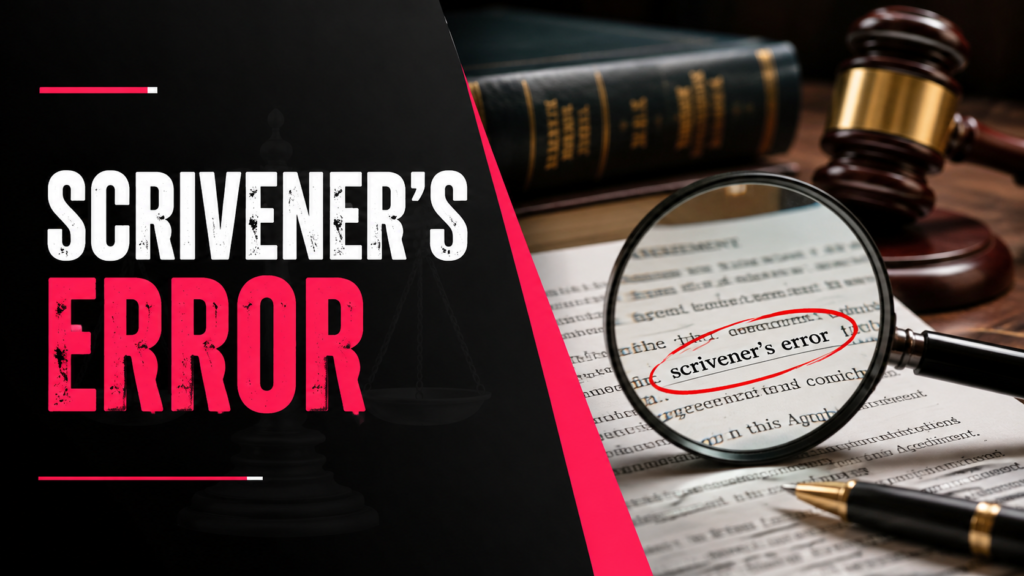
The doctrine of scrivener’s error (sometimes called vitium clerici, Latin for “fault of the scribe”) is an equitable principle that lets courts correct obvious clerical mistakes in written instruments. The idea is straightforward. Parties reach a genuine agreement. Someone then writes it down incorrectly. The writing does not match the true deal. Courts will not let a typo rewrite the bargain.
Courts treat the error as a failure in the reduction of the agreement to writing, not a failure in the agreement itself. Under the Restatement (Second) of Contracts § 155, a court may reform a written agreement when it fails to express the parties’ actual agreement because of a mistake in the writing process. The party seeking correction must prove the true prior understanding by clear and convincing evidence. That is a higher bar than the usual “more likely than not” civil standard. It exists to protect the strong presumption that a signed document reflects the parties’ real intent.
Real-world examples make the concept concrete. A purchase contract correctly identifies the house at 742 Maple Street, yet the legal description accidentally references the vacant lot next door. Both buyer and seller walked the larger property, exchanged emails confirming the address, and closed at a price consistent with the house. The wrong lot number is a classic scrivener’s error. Another common case: a divorce decree lists child support at $1,500 when the judge orally ordered $1,050 and both parties later confirm the lower figure. The higher number is a transcription mistake, not a change in the court’s ruling.
The doctrine is especially powerful in real estate because deeds and mortgages become part of the public record. An uncorrected error can cloud title for years, complicate refinancing, or create problems for future buyers and lenders. That is why many states have enacted specific curative statutes for certain limited errors in deeds.
Clerical Error vs. Substantive Contract Error
Not every mistake qualifies as a scrivener’s error. The distinction between a clerical error and a substantive contract error is critical.
A clerical error is mechanical. It is a typo, a transposed digit, a misspelled name, an omitted word, or a wrong cross-reference. The parties agreed on the substance. The writer simply recorded it wrong.
A substantive error goes to the heart of the deal. It involves a misunderstanding about a material term, the identity of the property, the amount of consideration, or the rights being transferred. Courts are far more reluctant to rewrite those terms under the doctrine of scrivener’s error.
Consider two scenarios. First, the contract states the purchase price as $250,000 when every negotiation email, the loan application, and the closing statement show $350,000. That is almost certainly a clerical error (a missing digit). Second, both parties believed the property was zoned commercial and priced it accordingly, only to discover after closing that it is residential. That is a mutual mistake about a basic assumption, not a scrivener’s error. The remedy may be rescission rather than simple reformation.
The parol evidence rule normally bars outside evidence that contradicts a complete written agreement. The doctrine of scrivener’s error creates a limited exception. When clear and convincing evidence shows the writing is the product of a drafting mistake, courts will consider earlier drafts, emails, texts, and testimony to restore the true intent. The evidence must be precise. Vague claims that “we meant something else” rarely succeed.
Scrivener’s Error in Real Estate Transactions
Real estate documents are fertile ground for these mistakes. Legal descriptions are long and technical. A single transposed number in a metes-and-bounds description, an incorrect lot or block number on a platted subdivision, or a misspelled grantee name can create lasting title problems.
Florida offers a useful illustration. Under Florida Statutes § 689.041, certain limited scrivener’s errors in deeds are cured by operation of law if specific conditions are met. The statute defines a scrivener’s error narrowly: an error or omission in no more than one lot or block identification, one unit or building identification in a condominium, or one directional designation or numerical fraction in a sectional description. The grantor must have held record title to the intended property, and the error must not be repeated across multiple properties the grantor owned in the same area within five years. When those conditions apply, the deed is treated as if it correctly described the intended real property.
Other states take different approaches. New Mexico, for example, authorizes a formal “scrivener’s-error affidavit” for a defined list of minor drafting or clerical problems (misspelled names, missing middle initials, omitted addresses, certain legal-description omissions). The affidavit must be executed by the attorney or title-company employee who prepared the original instrument and must be recorded.
Even without a special statute, the common-law doctrine remains available. Title companies and lenders routinely require corrective instruments before they will insure or finance a property that carries an obvious drafting flaw.
How to Correct a Scrivener’s Error in a Deed
The practical path depends on the severity of the error, whether all parties cooperate, and state law. Three main tools exist: the affidavit of correction (or scrivener’s affidavit), the corrective deed, and judicial reformation.
Affidavit of Correction or Scrivener’s Affidavit
For the most minor clerical mistakes, an affidavit of correction is often the fastest and least expensive option. The person who prepared the original deed (the attorney, title agent, or closing officer) signs a sworn statement under penalty of perjury. The affidavit identifies the original instrument by recording information (book and page or instrument number), describes the specific error, and states the correct information. Once recorded, it sits in the public record alongside the original deed and helps title examiners understand what was intended.
This method works well for misspelled names, incorrect middle initials, wrong dates, or obvious typographical glitches that do not change ownership or boundaries. It does not work when the error affects the identity of the parties, the property being conveyed, or material rights. Title companies may still insist on a stronger instrument if the mistake is borderline.
Corrective Deed
When the error is more significant (wrong legal description, incorrect vesting language, or a material transcription mistake), the standard tool is a corrective deed. This is a new deed that:
- Is titled “Corrective Deed” or “Correction Deed.”
- References the original deed by date, parties, and recording information.
- Explicitly identifies the error.
- Restates the correct information.
- Is signed and notarized by the original grantor (or the grantor’s authorized representative).
A corrective deed does not create a new transfer of title. It clarifies what the original deed was always meant to say. Because it is signed by the grantor, it carries more weight than a simple affidavit. Recording fees are usually modest (often $10–$80 depending on the county), and the process can be completed in a few days once the document is prepared and executed.
If the original grantor has died, cannot be located, or refuses to cooperate, a corrective deed becomes impractical. In those cases, parties must turn to the courts.
Judicial Reformation of Contract or Deed
When informal correction is unavailable, a party may petition a court for judicial reformation. Reformation is an equitable remedy. The court rewrites the instrument so that it matches the parties’ true prior agreement.
To succeed, the petitioner must present clear and convincing evidence of three elements:
- The parties reached a specific prior understanding.
- The written instrument fails to express that understanding because of a scrivener’s error (or mutual mistake in the reduction to writing).
- The proposed reformation accurately restores the true agreement without creating new terms.
Evidence can include earlier drafts, email chains, text messages, closing statements, loan applications, testimony from the drafter, and the parties’ subsequent course of performance. Courts look for a “specific prior contractual understanding” that tells them exactly what language to insert. They will not invent a contract the parties never made.
Reformation does not void the instrument. It corrects it. Once the court enters a judgment reforming the deed or contract, the corrected version is treated as if it had always been the original.
Common Pitfalls and How to Avoid Them
Even when the error is obvious, several obstacles can block correction.
Third-party reliance is the most serious. If a subsequent buyer, lender, or other innocent party reasonably relied on the erroneous recorded document and would be harmed by the change, a court may refuse reformation under the doctrine of equitable estoppel. Prompt correction is therefore essential. The longer an error sits in the public record, the greater the risk that someone has relied on it.
Another pitfall is treating a substantive disagreement as a mere clerical error. Courts guard against parties using the doctrine of scrivener’s error to rewrite a deal they later regret. If the evidence of prior agreement is weak or contradictory, reformation will be denied. The heavy presumption that a signed writing reflects true intent is not easily overcome.
Jurisdictional differences also matter. Some states have detailed statutory procedures for certain deed errors. Others rely entirely on common-law reformation. Always check local recording-office requirements and consult counsel familiar with the relevant state law before preparing a corrective instrument.
Finally, do not assume a notary can fix the problem. A notary may correct only the notarial certificate itself, not the body of the document.
Practical Steps for Real Estate Professionals and Parties
If you discover a possible scrivener’s error, follow this sequence:
- Obtain a certified copy of the recorded instrument and any related closing documents.
- Gather contemporaneous evidence of the parties’ true intent (emails, drafts, texts, appraisal reports, loan files).
- Determine whether the error is purely clerical or substantive.
- Contact the original preparer or title company. In many cases they will prepare and record the corrective instrument at little or no cost.
- If the grantor is available and cooperative, prepare and record a corrective deed.
- If cooperation is impossible or the error is disputed, consult a real estate attorney about filing a reformation action.
- Notify any affected lenders or title insurers so they can update their records and policies.
Prevention remains the best medicine. Careful proofreading of legal descriptions, use of modern title software that cross-checks parcel numbers, and dual review by both the drafting attorney and the title examiner catch most errors before recording.
Real-World Case Insights
Courts regularly apply these principles. In one Delaware Chancery case, a real estate joint-venture agreement contained waterfall provisions that produced an economically irrational result and departed from settled practice. The court reformed the agreement after finding clear and convincing evidence (including pre-signing emails) of the parties’ true prior understanding.
In another matter, a bank successfully obtained reformation of a deed that omitted a limitation present in the underlying purchase agreement. The court accepted testimony from a disinterested witness and found the omission was a classic scrivener’s error, not a change in the parties’ agreement.
These outcomes underscore a consistent theme: when the paper trail of true intent is strong and the mistake is clearly clerical, courts will correct the record.
Conclusion
A scrivener’s error is a clerical or typographical mistake that fails to express the parties’ actual agreement. The doctrine of scrivener’s error gives courts and parties practical tools (corrective deeds, affidavits of correction, and judicial reformation) to restore the true legal intent of the parties. Distinguishing these errors from substantive or mutual mistakes is essential, as is acting promptly before third parties rely on the defective record.
If you have discovered a possible drafting error in a deed, contract, or settlement agreement, gather your supporting documents and consult a qualified real estate or contract attorney in your jurisdiction. Early correction is almost always cheaper and cleaner than later litigation. Protect the deal you actually made.
Frequently Asked Questions
What is the difference between a scrivener’s error and a mutual mistake?
A scrivener’s error occurs when the parties agreed on terms and the writer recorded them incorrectly. A mutual mistake occurs when both parties shared a false belief about a material fact that formed the basis of the deal. Reformation is available for both, but the evidence and analysis differ.
Can I correct a scrivener’s error without going to court?
Yes, in most cases. An affidavit of correction or a corrective deed signed by the original grantor and recorded in the land records is often sufficient for clerical mistakes. Court action is needed only when parties refuse to cooperate or the error is disputed.
What standard of proof applies to judicial reformation?
Clear and convincing evidence. The party seeking reformation must overcome the strong presumption that a signed writing reflects the true agreement.
Does the parol evidence rule prevent correction of a scrivener’s error?
No. The doctrine creates a limited exception that allows courts to consider extrinsic evidence of the parties’ true prior understanding when the writing is the product of a drafting mistake.
How long do I have to correct a scrivener’s error in a deed?
There is no universal statute of limitations for reformation, but delay creates practical problems. Third-party reliance and the unavailability of witnesses or the original grantor make later correction harder and more expensive. Act as soon as the error is discovered.
Will a title company accept an affidavit of correction?
For minor clerical issues, many will. For anything that affects the legal description, vesting, or material rights, most title companies prefer or require a corrective deed.
Can a scrivener’s error invalidate an entire contract or deed?
Generally no. Courts prefer to reform the instrument to match the true agreement rather than void it, provided the error is clerical and the true intent can be proven.