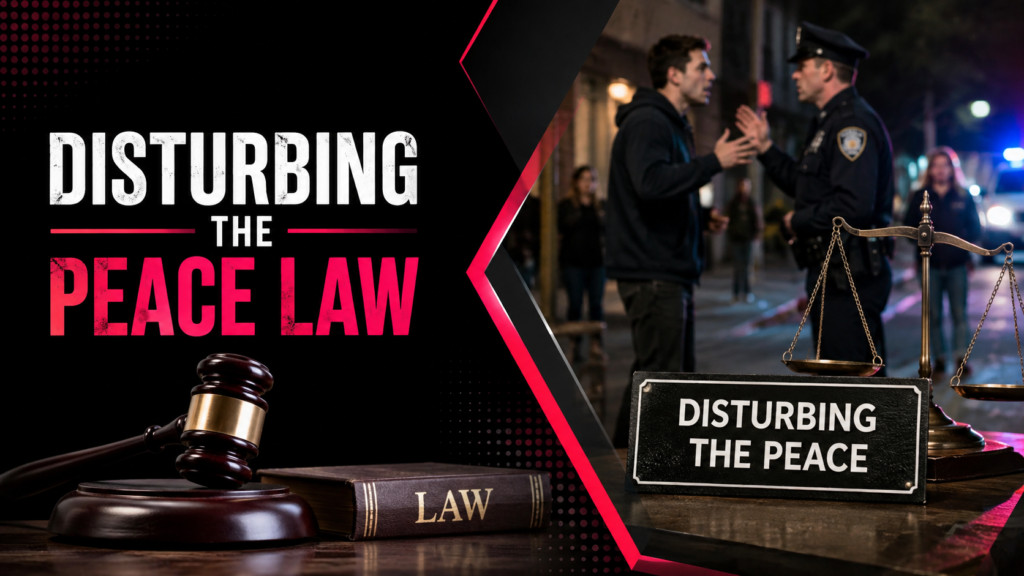

Loud music at midnight. A heated argument that spills onto the sidewalk. A fight outside a bar. These everyday moments can quickly turn into criminal charges under disturbing the peace law. Thousands of people each year face citations or arrests for behavior that disrupts public order, often without realizing the legal line they crossed. This guide breaks down what the law actually means, the most common violations, typical penalties, and practical defenses so you can understand your rights and options.
Whether you received a citation, worry about a neighbor dispute, or simply want clarity on public order rules, the information here is designed to help. Laws differ by state, so always check your local statutes or speak with a qualified attorney for advice specific to your situation.
What Is Disturbing the Peace Law?
Disturbing the peace law (also called breach of the peace in many places) makes it a crime to engage in conduct that disrupts public tranquility or creates a risk of violence or disorder. It is one of the most frequently charged public order offenses across the United States. Nearly every state has a version of this rule, though the exact wording and penalties vary.
At its core, the offense targets behavior that goes beyond ordinary annoyance. A single complaint from a sensitive neighbor is rarely enough. Prosecutors usually must show that the conduct would disturb a reasonable person under the circumstances. Time of day, location, volume, and intent all matter.
Many states treat the charge as a misdemeanor or, in milder cases, an infraction similar to a traffic ticket. Some jurisdictions use the term disorderly conduct for overlapping or broader behavior. Others keep breach of peace as a distinct category. The practical result is similar: the government seeks to maintain quiet, safety, and order in public spaces.
Key Elements Prosecutors Must Prove
Most statutes require proof of several common elements:
- The defendant engaged in prohibited conduct (fighting, unreasonable noise, or provocative words).
- The conduct occurred in a public place or affected people outside private property.
- The defendant acted willfully, maliciously, or with intent (or at least recklessly in some states).
- The behavior actually disturbed or was likely to disturb others under an objective standard.
California Penal Code section 415 offers a clear illustration used by many other states. It prohibits three specific acts: unlawfully fighting or challenging someone to fight in public, maliciously and willfully disturbing another with loud and unreasonable noise, or using offensive words in public that are inherently likely to provoke immediate violence.
Other states expand the list. Texas Penal Code section 42.01 covers abusive language, offensive gestures, unreasonable noise, fighting, and even displaying a firearm in a way that alarms others. New York treats many of these acts as disorderly conduct under Penal Law section 240.20.
The Supreme Court has limited how far these laws can reach. In cases such as Cox v. Louisiana and Cohen v. California, courts struck down overly vague or broad applications that punished unpopular speech or peaceful protest. Fighting words (personal insults likely to trigger immediate violence) remain unprotected, but general vulgarity or political speech usually stays protected.
Common Examples of Disturbing the Peace Violations
Real-world scenarios help clarify where the line sits. Here are frequent situations that lead to charges:
Unreasonable noise. Playing music or using amplifiers at high volume late at night in a residential area is a classic trigger. Construction noise during restricted hours, barking dogs left unattended for hours, or shouting matches that wake neighbors can also qualify when the noise is willful and excessive.
Fighting in public. A mutual combat outside a restaurant, a parking-lot altercation, or challenging someone to a fight on a sidewalk often results in dual arrests. Even if both parties agreed to the fight, the public nature of the act can support the charge.
Offensive or fighting words. Yelling personal insults face-to-face in a way that a reasonable person would expect to provoke an immediate violent reaction can cross the line. General cursing or political slogans usually do not.
Tumultuous or disruptive group behavior. Gathering in a way that blocks sidewalks, creates chaos at a public event, or escalates into near-riot conditions may lead to charges, sometimes overlapping with unlawful assembly rules.
Other frequent triggers. Public arguments that draw a crowd, throwing objects in a crowded area, or creating noxious odors in public spaces appear in many police reports.
Private conduct inside a home rarely qualifies unless the noise or behavior clearly affects neighbors or the public. Accidental noise (a car alarm that will not stop, a dog that barks while the owner is away) typically lacks the required intent.
Local noise ordinance rules often run parallel to state disturbing the peace statutes. A city may set specific decibel limits or quiet hours. Violating the ordinance can result in a civil citation, while more extreme or willful conduct may lead to the criminal charge. The two are related but not identical.
How Charges Are Filed and the Typical Process
Police usually respond to a complaint or witness the conduct themselves. An officer may issue a citation on the spot or make an arrest if the situation is volatile. In many jurisdictions the charge is filed as either an infraction or a misdemeanor at the prosecutor’s discretion.
After the citation or arrest, the defendant receives a court date. First appearances often involve entering a plea. Many cases resolve through plea negotiations, diversion programs, or dismissal when evidence is weak. First-time offenders frequently avoid jail through probation, community service, or anger-management classes.
Because the offense sits low on the severity scale, prosecutors sometimes use it as a plea-bargain reduction from more serious charges such as assault or resisting arrest. That flexibility works both ways: a skilled defense attorney can often negotiate a reduction from misdemeanor to infraction or seek outright dismissal.
Penalties for Disturbing the Peace
Penalties depend heavily on the state, the specific facts, and the defendant’s record. Most jurisdictions treat a standard first offense as a low-level misdemeanor.
Typical ranges include:
- Fines from roughly $100 to $1,000 (plus court costs and penalty assessments that can multiply the base amount).
- Jail time of up to 30, 90, or occasionally 180 days, though actual incarceration for first offenders is uncommon.
- Probation lasting several months to a year.
- Community service hours.
- Mandatory classes (anger management, alcohol education, or noise-awareness programs in some areas).
California provides a concrete example. Under Penal Code 415, the charge can be filed as an infraction (fine up to about $250, no jail, no criminal record) or as a misdemeanor (up to 90 days in county jail and/or a $400 fine). Penalty assessments often increase the real cost well beyond the base fine.
Texas generally classifies disorderly conduct as a Class C misdemeanor with a fine up to $500. If a firearm is involved, it can rise to a Class B misdemeanor with possible jail time up to 180 days and a $2,000 fine. New York treats disorderly conduct as a violation, carrying up to 15 days in jail and/or a $250 fine.
Aggravating factors raise the stakes. Conduct on school grounds, repeat offenses, involvement of weapons, or behavior that escalates into violence can lead to enhanced penalties or additional charges. A conviction can appear on background checks, affecting employment, housing, professional licenses, or immigration status in some cases. Infractions usually do not create a criminal record.
Legal Defenses That Can Defeat or Reduce Charges
Many disturbing the peace cases are defensible. Common successful strategies include:
Lack of intent. Most statutes require willful, malicious, or knowing conduct. Accidental noise, a misunderstanding about volume, or behavior the defendant did not realize was disturbing others can defeat the charge. Prosecutors must prove the mental element beyond a reasonable doubt.
Conduct was not actually disruptive. The standard is objective. If a reasonable person would not have been disturbed under the same circumstances, the charge may fail. A single hypersensitive complainant is often insufficient.
Self-defense or defense of others. When the charge arises from a fight, evidence that the defendant responded proportionally to an initial attack can negate the “unlawful” element. Witness statements, video, and injury patterns help establish this defense.
First Amendment protection. Political speech, peaceful protest, religious expression, and artistic performance receive strong constitutional protection. Courts require more than mere offensiveness. The speech must fall into the narrow “fighting words” category or violate valid time, place, and manner restrictions before it loses protection.
Insufficient evidence or false accusation. Neighbor disputes sometimes generate retaliatory complaints. Misidentification in chaotic scenes is another frequent issue. Defense counsel can subpoena records, obtain surveillance video, and cross-examine witnesses to expose weaknesses.
Private property or lack of public impact. Conduct confined to private property that does not affect the public may fall outside the statute’s reach.
Police overreach or constitutional violations. Unlawful stops, fabricated reports, or selective enforcement can support motions to suppress or dismiss.
An experienced criminal defense attorney evaluates the specific statute, the evidence, and local court practices to choose the strongest approach. Early intervention often produces better results than waiting until the court date.
Disturbing the Peace Compared With Related Offenses
People often confuse disturbing the peace law with disorderly conduct, public nuisance, or unlawful assembly. The distinctions matter for charging decisions and potential penalties.
Disorderly conduct is frequently broader. It may include public intoxication, blocking traffic, or creating hazardous conditions. Some states use the terms interchangeably. Others keep them separate, with disorderly conduct carrying slightly higher maximum penalties in certain cases.
Public nuisance usually focuses on ongoing interference with community rights (persistent noise, odors, or obstruction) and may be pursued civilly as well as criminally.
Unlawful assembly targets groups that gather with intent to commit a crime or create a disturbance. It often requires multiple participants and can escalate into riot charges if violence occurs.
Understanding these differences helps defendants and their lawyers anticipate how prosecutors may frame the case and what lesser-included or alternative charges might appear in negotiations.
Practical Steps If You Face a Charge
- Remain calm and polite with officers. Anything you say can be used later.
- Document everything as soon as possible: time, location, witnesses, photos, videos, and the exact words of any complaint.
- Do not discuss the incident on social media.
- Contact a criminal defense attorney promptly. Many offer free or low-cost initial consultations.
- Gather evidence that supports lack of intent, self-defense, or protected speech.
- Attend all court dates. Missing one can lead to a bench warrant.
Diversion programs, deferred adjudication, or informal probation are common outcomes for first-time, non-violent cases. Completing the required conditions often results in dismissal or a reduced record.
Conclusion
Disturbing the peace law exists to protect the community’s right to reasonable quiet and safety, yet it is written broadly enough that ordinary people can find themselves charged after a loud party, a sidewalk argument, or a noise complaint. Understanding the elements, typical misdemeanor penalties, and available legal defenses puts you in a stronger position. Intent, reasonableness, location, and constitutional protections all play major roles in how these cases resolve.
If you or someone you know faces a citation or arrest, do not treat it as a minor inconvenience. A conviction can carry lasting consequences. Consult a qualified criminal defense attorney in your jurisdiction to review the facts, evaluate defenses, and protect your rights. Early, informed action often leads to the best outcome.
Frequently Asked Questions
Is disturbing the peace a misdemeanor or an infraction?
It depends on the state and the facts. Many jurisdictions allow prosecutors to file it as either a low-level misdemeanor or a non-criminal infraction. Infractions usually carry only a fine and no criminal record.
What is the difference between a noise ordinance and disturbing the peace?
Noise ordinances are typically local civil rules that set specific volume limits or quiet hours. Violating them often results in a ticket. Disturbing the peace is a state criminal statute that requires willful or malicious conduct that actually disturbs others under an objective standard. Extreme or repeated noise violations can support the criminal charge.
Can I go to jail for a first-time disturbing the peace charge?
Jail is possible under most statutes, but judges rarely impose it on first offenders for minor conduct. Fines, probation, community service, or diversion are far more common.
Does a conviction show up on a background check?
A misdemeanor conviction usually appears on standard background checks. An infraction typically does not create a criminal record.
Is yelling or using bad language enough for a charge?
Not by itself. The words must be used in a public place and be inherently likely to provoke an immediate violent reaction (fighting words). General profanity or political speech is usually protected by the First Amendment.
How long do I have to fight the charge?
Statutes of limitations are generally short (often one year for misdemeanors). Court deadlines for responding to a citation are much tighter, sometimes only days or weeks. Act quickly.
Can peaceful protest lead to a disturbing the peace charge?
Peaceful, non-violent protest is protected. Charges become more likely if the demonstration involves unreasonable noise that disrupts others outside valid time/place/manner rules, blocks access, or escalates into fighting or threats.
You May Also Like: Adesola Miller OWI Charges: Details and Legal Implications