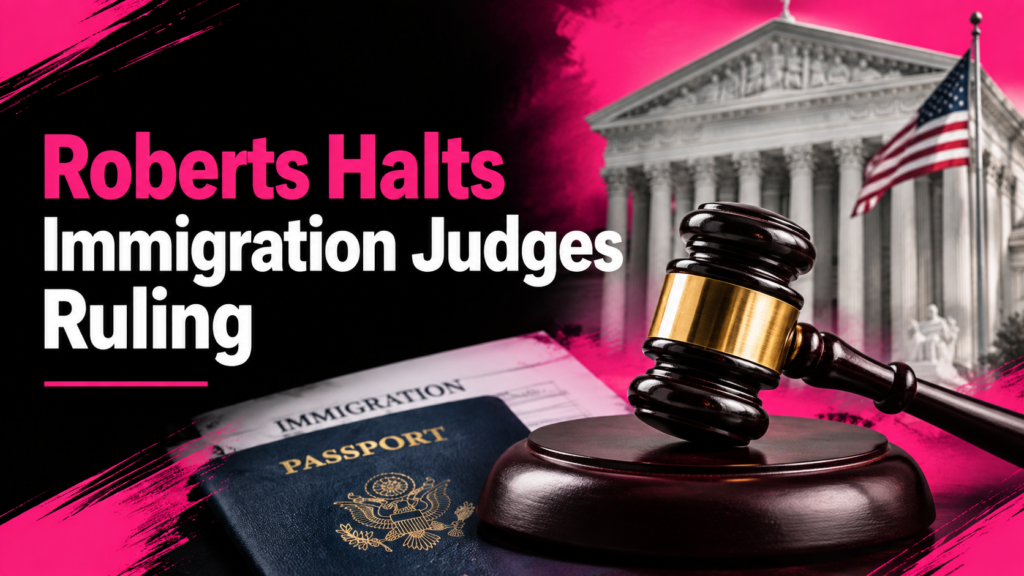

Chief Justice John Roberts issued an administrative stay in December 2025 that temporarily blocked a Fourth Circuit ruling in a high-stakes free speech dispute involving immigration judges. The order paused a mandate that would have sent the National Association of Immigration Judges’ challenge back to district court for fact-finding on whether the Civil Service Reform Act’s administrative scheme still functions as Congress intended.
This intervention highlights ongoing tension between executive branch oversight of administrative adjudicators and First Amendment protections for public employee speech. Immigration judges, who serve as Department of Justice employees within the Executive Office for Immigration Review rather than Article III judges, have long faced restrictions on public comments about immigration law and agency operations.
The stay, requested by the government on an emergency basis, underscores how procedural questions about venue and exhaustion can shape the path of constitutional claims. This article examines the underlying policy, the litigation history, the legal standards governing public employee speech, the significance of Roberts’ action, and the subsequent developments that followed.
Background on the EOIR Speech Policy
The Executive Office for Immigration Review oversees the nation’s immigration courts and employs hundreds of immigration judges who decide removal cases and related matters. These judges are appointed by the Attorney General and operate as part of the executive branch.
In 2017, during the first Trump administration, EOIR issued guidance requiring prior approval for many speaking engagements. A more restrictive 2020 version treated nearly any discussion of immigration law, policy, or EOIR programs as official speech subject to supervisory control. The 2021 policy, issued under the Biden administration, refined the framework while retaining core limitations.
Under the operative policy, immigration judges must obtain supervisory and ethics approval for speeches or writings that relate to their official duties or agency programs. Speech deemed official capacity effectively requires the judge to serve as a representative of the agency rather than offering personal views. Critics, including the National Association of Immigration Judges, describe the rules as a prior restraint that chills discussion of matters of significant public concern.
Supporters of the policy emphasize the need to preserve the appearance of impartiality. Immigration judges handle high-volume dockets involving sensitive enforcement decisions. Unrestricted public commentary, the government has argued, risks creating perceptions of bias that could undermine confidence in the administrative process.
The National Association of Immigration Judges, a voluntary association of non-supervisory immigration judges, challenged the policy in federal court in 2020. Represented in part by the Knight First Amendment Institute, the group contended that the restrictions violate the First Amendment rights of the judges and the public’s corresponding right to hear from them.
Litigation Path Leading to the Stay
The district court in the Eastern District of Virginia dismissed the suit in 2023. It held that the Civil Service Reform Act of 1978 channels personnel and employment-related claims by federal employees into an exclusive administrative scheme. That scheme begins with the Office of Special Counsel and proceeds to the Merit Systems Protection Board, with limited subsequent judicial review.
The Fourth Circuit reversed in June 2025. A unanimous panel vacated the dismissal and remanded for further proceedings. The court noted recent executive actions, including the removal of leadership at the Office of Special Counsel and the Merit Systems Protection Board, that raised questions about whether those bodies continued to operate with the independence Congress contemplated when it enacted the CSRA. The panel directed the district court to develop a factual record on the continued vitality of the administrative scheme.
The government sought rehearing en banc, which the full Fourth Circuit denied. The mandate was scheduled to issue in early December 2025. On December 5, Solicitor General D. John Sauer filed an emergency application with the Supreme Court seeking a stay of the mandate pending a forthcoming petition for certiorari.
Chief Justice Roberts, as Circuit Justice for the Fourth Circuit, promptly entered an administrative stay. The order held the Fourth Circuit’s mandate in abeyance pending further action by the Chief Justice or the full Court and set a short briefing schedule for the respondents.
An administrative stay of this kind is a temporary procedural device. It does not resolve the merits. It simply preserves the status quo long enough for the Court to consider whether more formal relief is warranted.
Public Employee Speech and First Amendment Standards
Understanding the constitutional stakes requires attention to the framework governing speech by government employees. The Supreme Court has long recognized that public employees do not surrender all First Amendment rights by accepting government employment. At the same time, the government has legitimate interests in regulating speech that interferes with efficient operations or the appearance of impartiality.
In Pickering v. Board of Education (1968), the Court established a balancing test. Courts weigh the employee’s interest in speaking on matters of public concern against the government’s interest in promoting the efficiency of the public services it performs. Later cases refined the inquiry. Connick v. Myers (1983) emphasized that speech must address a matter of public concern to trigger protection. Garcetti v. Ceballos (2006) held that when public employees make statements pursuant to their official duties, the First Amendment does not insulate them from employer discipline.
Immigration judges occupy a distinctive position. They exercise significant adjudicative authority yet remain executive branch employees subject to Attorney General oversight. Their speech about immigration law and policy often involves matters of intense public interest. At the same time, the government maintains that unapproved public commentary risks compromising the perceived neutrality of the immigration courts.
The challenged EOIR policy functions as a prior restraint. Prior restraints on speech carry a heavy presumption against constitutional validity. Courts scrutinize them carefully, particularly when they require government approval before expression can occur. The National Association of Immigration Judges has argued that the policy’s breadth and the discretionary nature of the approval process render it unconstitutional.
The government has countered that the restrictions are content-neutral ethics measures designed to protect the integrity of the administrative process, not viewpoint-based censorship. Whether the policy can survive First Amendment scrutiny remains unresolved because the litigation has largely turned on threshold questions of jurisdiction and exhaustion.
Significance of Roberts’ Administrative Stay
Roberts’ December 5 order did not address the merits of the free speech claim or the Fourth Circuit’s reasoning about the CSRA. It simply paused the lower court’s mandate. Such stays are common on the Court’s emergency docket when a party asserts that implementation of a lower court order will cause irreparable harm or complicate further review.
The government’s application argued that the Fourth Circuit’s decision was clearly contrary to Supreme Court precedent on the exclusivity of the CSRA scheme. It warned that allowing the district court to proceed with fact-finding into the internal operations of the Office of Special Counsel and Merit Systems Protection Board would produce disruptive discovery and raise separation-of-powers concerns.
The National Association of Immigration Judges responded that the government had not shown irreparable harm. The association stressed that the Fourth Circuit had not declared the CSRA inapplicable across the board. It had merely ordered targeted fact-finding to determine whether the administrative scheme still operated as Congress intended. The association also highlighted the ongoing First Amendment injury: every day the speech policy remained in force, immigration judges were silenced on issues of public importance.
Two weeks later, on December 19, 2025, the full Supreme Court denied the stay application. In a brief unsigned order, the Court stated that the government had not demonstrated irreparable harm at that stage. The denial was without prejudice to a renewed application if the district court commenced discovery before the Court disposed of a forthcoming certiorari petition. The Chief Justice’s earlier administrative stay was vacated.
The sequence illustrates the careful calibration that often characterizes emergency stay practice. An initial administrative stay buys time. The subsequent full-Court decision then evaluates whether the moving party has met the higher threshold for continued relief.
Implications for Administrative Law and Judicial Independence
The case sits at the intersection of several important doctrines. First, it tests the limits of the CSRA’s exclusive remedial scheme. Congress designed that scheme to provide a comprehensive, centralized process for federal employee grievances while limiting district court interference in routine personnel matters. Courts have generally enforced the exclusivity principle rigorously.
Second, the litigation raises questions about the independence of administrative adjudicators. Immigration judges are not Article III judges. Their tenure and conditions of employment are governed by statutes and regulations that place them firmly within the executive branch. Yet they perform adjudicative functions that demand a measure of decisional independence. Restrictions on their ability to speak publicly about the system in which they work can affect both their professional autonomy and the public’s understanding of immigration adjudication.
Third, the case engages broader debates about the unitary executive and the President’s control over independent or quasi-independent components of the executive branch. Actions affecting the leadership of the Merit Systems Protection Board and Office of Special Counsel formed part of the Fourth Circuit’s rationale for ordering further fact-finding. Those personnel decisions themselves have generated separate litigation concerning removal protections.
For immigration practitioners and constitutional scholars, the dispute underscores how procedural doctrines can delay or reshape the adjudication of First Amendment claims. Venue and exhaustion requirements matter. When those requirements channel constitutional challenges into administrative forums whose independence is itself contested, the practical availability of judicial review becomes a live issue.
Subsequent Developments and Next Legal Steps
After the December 19 denial of the stay, the government filed a petition for a writ of certiorari. The National Association of Immigration Judges filed a conditional cross-petition seeking broader review of the question whether federal employees may challenge prior restraints on speech directly in federal court.
On May 26, 2026, the Supreme Court granted the government’s petition, reversed the Fourth Circuit, and remanded. In a per curiam opinion, the Court held that the Fourth Circuit had violated the party-presentation principle by deciding the case on a ground the parties had not raised. Justice Thomas, joined by Justice Barrett, filed a concurrence that criticized the appeals court for responding to political controversies of the day.
The decision did not resolve the constitutionality of the EOIR speech policy. It returned the case to the Fourth Circuit for further proceedings consistent with the party-presentation principle. As a result, the threshold question of whether the CSRA requires exhaustion remains open for proper presentation and decision on remand.
Looking ahead, several paths remain possible. The parties may litigate the jurisdictional issue more carefully in the lower courts. If the administrative scheme is held to apply, the National Association of Immigration Judges would need to pursue its claims through the Office of Special Counsel and Merit Systems Protection Board before seeking judicial review. Alternatively, if a court ultimately concludes that the CSRA does not bar direct judicial challenges to broad prior restraints of this character, the First Amendment merits would finally receive focused attention.
Practitioners monitoring the case should watch for any renewed emergency applications if discovery disputes arise, as well as for developments in related litigation concerning the structure and independence of the civil service agencies. Legislative attention to the status of immigration judges as administrative adjudicators remains another potential avenue for reform.
Key Takeaways for Legal Professionals
Roberts’ administrative stay temporarily halted implementation of the Fourth Circuit’s remand order and illustrated the Supreme Court’s readiness to pause lower-court mandates pending fuller consideration. The subsequent denial of a longer stay and the later merits decision on party presentation demonstrate that the Court has so far treated the dispute primarily as one of procedural regularity rather than substantive free speech doctrine.
The underlying constitutional questions retain full vitality. Public employee speech doctrine continues to require careful balancing. Administrative agencies retain authority to impose ethics and impartiality restrictions, yet those restrictions remain subject to First Amendment limits when they operate as prior restraints on speech about matters of public concern.
Immigration law practitioners, constitutional scholars, and policy analysts should continue tracking both the remand proceedings and parallel cases that test the boundaries of executive control over administrative personnel. Clear resolution of the speech policy’s validity would provide needed guidance for immigration judges, agency managers, and the public that relies on transparent adjudication.
Frequently Asked Questions
What exactly did Chief Justice Roberts order in December 2025?
He entered an administrative stay of the Fourth Circuit’s mandate in Margolin v. National Association of Immigration Judges. The order prevented the appeals court’s remand from taking effect while the Supreme Court considered the government’s emergency application.
Does the stay resolve the First Amendment claim?
No. The administrative stay and the later full-Court denial of a longer stay addressed only the timing of the lower-court proceedings. The constitutionality of the EOIR speech policy has not been decided on the merits.
Why does the Civil Service Reform Act matter in this case?
The government contends that the CSRA provides the exclusive avenue for federal employees to challenge personnel policies, including speech restrictions. The National Association of Immigration Judges argues that broad prior restraints on speech about matters of public concern should be challengeable directly in federal court.
Are immigration judges Article III judges?
No. They are executive branch employees appointed by the Attorney General and supervised by the Executive Office for Immigration Review within the Department of Justice.
What happened after the December 2025 stay proceedings?
The Supreme Court ultimately reversed the Fourth Circuit in May 2026 on the ground that the appeals court had decided the case on an issue not raised by the parties. The case returned to the Fourth Circuit for further proceedings.
Can immigration judges speak publicly at all under the current policy?
They may seek approval for official-capacity speeches. Personal-capacity speech on topics related to their official duties or agency programs remains heavily restricted.
Where can practitioners find the official court documents?
Supreme Court orders and dockets are available on the Court’s website. Lower-court opinions appear in the Federal Reporter and on public dockets maintained by the Fourth Circuit and the Eastern District of Virginia.
You May Also Like: Sarah Holler Manifest Law: Key Facts and Legal Questions