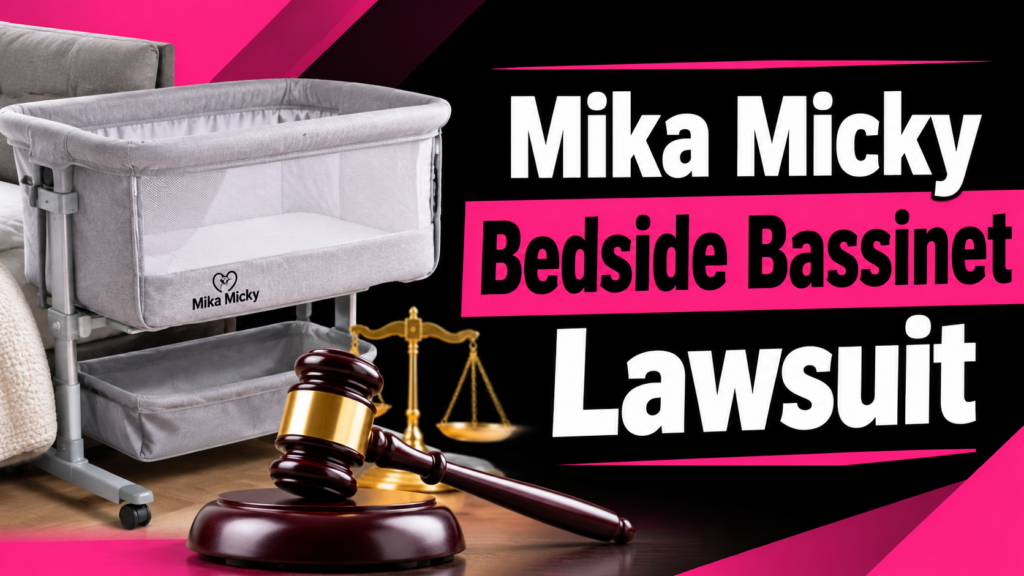

Every year, thousands of families turn to bedside sleepers hoping for safer, closer rest with their newborns. Yet one Minnesota family’s experience has raised serious questions about a popular product sold widely online. In late 2025, a father filed a wrongful death lawsuit claiming a Mika Micky bedside bassinet contributed to his infant daughter’s death by suffocation. This article explains the Mika Micky Bedside Bassinet Lawsuit, the safety concerns at issue, relevant standards from the CPSC and American Academy of Pediatrics, and the legal options available to families.
The goal is straightforward: give parents clear information so they can protect their children and understand their rights if harm has already occurred.
What Happened in the Mika Micky Lawsuit
In December 2025, David Sullivan filed a complaint in Minnesota state court as trustee for the next of kin of his daughter, Summer Sullivan (also referred to in court papers as S.S.). The case was later removed to the U.S. District Court for the District of Minnesota.
According to the complaint, Sullivan purchased a Mika Micky bedside bassinet on Amazon in 2020. On February 16, 2023, he placed his five-month-old daughter down for a nap in the product at the family’s home in Shoreview, Minnesota. Shortly afterward, he found her unresponsive with her face pressed against the side of the bassinet. Emergency responders tried to revive her. She was taken to Children’s Minnesota–St. Paul but never regained consciousness and later died from complications of asphyxia caused by airway occlusion.
The lawsuit names two defendants: Amazon.com Inc. and Redline Commerce Inc., which does business as Mika Micky. It alleges the bassinet was defectively designed and unreasonably dangerous because parts of its sides allowed an infant’s face to become pressed against areas that restricted airflow. The complaint asserts claims of strict product liability, design defect, failure to warn, negligence, and breach of express and implied warranties. It further claims Amazon failed to exercise reasonable care in selling and distributing an infant sleep product.
As of mid-2026 court filings, Redline Commerce had not appeared in the case, prompting a motion for default judgment that was denied without prejudice to avoid inconsistent outcomes if Amazon continued to defend the suit. The case remains ongoing. Allegations in a complaint are not findings of fact or liability. Courts have not yet ruled on the merits.
Alleged Design Concerns and Infant Suffocation Risk
The core of the claim centers on positional asphyxia and infant suffocation risk. Positional asphyxia occurs when an infant’s body position restricts breathing, often when the face presses into a soft or insufficiently firm surface that blocks the nose and mouth or interferes with normal gas exchange.
Plaintiffs allege that portions of the Mika Micky bassinet’s sides were insufficiently firm and created “occlusion zones.” Even when used as intended, the design allegedly allowed a baby’s face to press against fabric or mesh areas in a way that substantially increased the risk of restricted airflow. The product features breathable mesh walls and is marketed as a bedside co-sleeper that can also stand alone. Critics of similar products have long noted that mesh or fabric sides, if not sufficiently rigid or properly tensioned, can still pose hazards if an infant rolls or shifts against them.
These concerns fit a broader pattern of scrutiny around infant sleep products. Over the past decade, inclined sleepers, rockers, and certain bassinets have faced recalls and lawsuits after reports of infants rolling into positions that blocked their airways. The Mika Micky product is not an inclined sleeper; it is designed as a flat-surface bedside bassinet. Still, the lawsuit argues its specific side construction created foreseeable risks.
No widespread CPSC recall of the Mika Micky bedside bassinet appears in public records as of late 2026. Individual product liability cases can still proceed based on specific design or warning defects even without a formal recall.
CPSC Standards and Safe Sleep Requirements
The U.S. Consumer Product Safety Commission sets mandatory standards for infant sleep products. Bedside sleepers must comply with 16 C.F.R. part 1222, which incorporates ASTM F2906 (the Standard Consumer Safety Specification for Bedside Sleepers) with certain modifications. These products must also meet the requirements of the Safety Standard for Bassinets and Cradles (16 C.F.R. part 1218).
Key requirements include:
- A firm, flat sleep surface.
- Minimum barrier heights around the perimeter.
- Secure attachment to the adult bed when used in bedside mode.
- Limits on openings that could create entrapment hazards.
- Stability and structural integrity testing.
In 2022, the CPSC’s Infant Sleep Products Rule took effect. It requires any product marketed or intended for infant sleep (up to about 5 months) to meet one of the existing federal standards for cribs, bassinets, play yards, or bedside sleepers. Products that do not meet these standards cannot lawfully be sold. The rule was designed to remove non-compliant inclined and flat sleep products from the market.
Parents should check current CPSC guidance and product labeling. The agency maintains resources on safe sleep products at cpsc.gov. Reporting incidents through saferproducts.gov helps regulators track patterns.
American Academy of Pediatrics Safe Sleep Rules
The American Academy of Pediatrics (AAP) issues evidence-based recommendations to reduce the risk of sleep-related infant deaths, including SIDS and accidental suffocation. The 2022 policy statement remains the primary reference.
Core AAP guidance includes:
- Place babies on their backs for every sleep.
- Use a firm, flat, non-inclined sleep surface that meets current safety standards.
- Keep the sleep area free of soft bedding, pillows, blankets, toys, and bumper pads.
- Room-share without bed-sharing for at least the first six months.
- Avoid products not specifically designed and tested for infant sleep.
Bedside sleepers can support room-sharing when they meet standards and are used correctly. The AAP emphasizes that the safest sleep environment is simple: a firm, flat surface with no extra items, in the parents’ room but on a separate surface. Soft or yielding sides that allow the face to sink or press into material increase risk.
Parents considering any co-sleeper or bassinet should verify it complies with current CPSC standards, has clear age and weight limits, and shows no signs of wear or loose fabric that could create hazards.
Amazon Product Liability and Third-Party Seller Issues
Amazon sells millions of third-party products. In product liability cases involving items sold on the platform, plaintiffs often argue that Amazon acts as more than a neutral marketplace. Courts have reached differing conclusions depending on the facts, the degree of Amazon’s involvement in fulfillment, and state law.
In the Mika Micky case, the complaint alleges Amazon marketed, sold, and distributed the bassinet through its platform and Prime delivery, and that it had a duty to ensure the product was reasonably safe for its intended use. Redline Commerce is identified as the manufacturer or primary seller doing business as Mika Micky.
Amazon third-party seller liability remains an evolving area. Some courts have found Amazon can be treated as a seller under strict liability theories in certain circumstances. Other cases have limited its exposure. Families pursuing claims typically name both the brand/manufacturer and the platform when evidence supports it. Outcomes depend on the specific facts, the product’s path to the consumer, and applicable state product liability rules.
Legal Options for Families
If your family has experienced injury or death involving a Mika Micky or similar bedside sleeper, several paths may be available. These are general observations, not legal advice. Consult a qualified attorney in your state for guidance specific to your situation.
Wrongful death claims allow certain family members or a representative to seek damages for the death of a loved one. Recoverable elements can include medical and funeral expenses, loss of companionship, and, in some states, conscious pain and suffering of the deceased.
Product liability theories commonly include:
- Design defect (the product was unreasonably dangerous as designed).
- Manufacturing defect (a flaw in a particular unit).
- Failure to warn (inadequate instructions or warnings about known risks).
Negligence claims focus on whether the manufacturer or seller failed to exercise reasonable care in designing, testing, marketing, or selling the product.
Breach of warranty claims assert that the product did not meet express or implied promises of safety and fitness for infant sleep.
Steps families often take:
- Preserve the product and all packaging, receipts, and instructions.
- Document the incident thoroughly (photos, medical records, witness statements).
- Report the incident to the CPSC through saferproducts.gov.
- Consult an experienced product liability or personal injury attorney who handles infant product cases.
- Be mindful of statutes of limitations, which vary by state and can be short.
Compensation eligibility depends on proof of defect, causation, damages, and other legal elements. Not every incident results in a viable claim. Early consultation helps families understand realistic options.
Practical Safety Checklist for Parents
Regardless of any lawsuit, families can take concrete steps today:
- Confirm any sleep product meets current CPSC standards for bassinets or bedside sleepers.
- Use only a firm, flat mattress with a tight-fitting sheet. Nothing else in the sleep space.
- Place baby on their back for every sleep.
- Check mesh or fabric sides regularly for sagging, tears, or areas where a face could press in.
- Stop using the product once the baby reaches the manufacturer’s weight or developmental limit (often when they can push up or roll).
- Prefer products with clear tracking labels, compliance statements, and reputable testing documentation.
- Room-share with a separate safe sleep surface rather than bed-sharing.
- Avoid secondhand or heavily used sleep products whose history is unknown.
If you already own a Mika Micky unit, inspect it carefully. Consider whether continuing use aligns with current safety guidance and your comfort level. Many families transition to a standard crib or play yard that meets full federal standards once the baby outgrows the bassinet stage.
Broader Context of Infant Product Safety Litigation
The Mika Micky case sits within a larger landscape of infant sleep product litigation. Inclined sleepers, certain rockers, and other products have generated recalls, warnings, and multi-million-dollar settlements after reports of infant deaths. Regulatory pressure has increased, and manufacturers face closer scrutiny of design, testing, and marketing claims.
Third-party marketplace sales add complexity. Consumers often assume products listed on major platforms have been thoroughly vetted. Litigation continues to test the boundaries of platform responsibility. For parents, the practical takeaway remains consistent: prioritize products that clearly meet mandatory federal standards and follow AAP safe sleep rules without exception.
Conclusion
The Mika Micky Bedside Bassinet Lawsuit highlights painful questions about design, testing, and the sale of products intended for the most vulnerable consumers. One family’s loss has brought allegations of fabric wall hazard, restricted airflow, and inadequate safeguards into public view. While the case is still pending and liability has not been established, the facts underscore why strict adherence to CPSC standards and AAP safe sleep recommendations matters so much.
Parents and caregivers deserve clear information and products that perform as promised. If your family has been affected by an incident involving this or a similar product, speak with a qualified attorney who can evaluate the specific facts under your state’s law. In the meantime, keep sleep environments simple, firm, flat, and free of anything that could block a baby’s airway. Your vigilance is one of the strongest protections available.
Frequently Asked Questions
Is there an official recall of the Mika Micky bedside bassinet?
No widespread CPSC recall of the Mika Micky product appears in public records as of late 2026. Individual lawsuits can still proceed based on specific defect claims.
What is the status of the Mika Micky Bedside Bassinet Lawsuit?
The case was filed in late 2025, removed to federal court in Minnesota, and remains pending. A default judgment motion against the manufacturer was denied without prejudice. No final determination of liability has been made.
Can Amazon be held liable for third-party products?
It depends on the facts and state law. Some courts have allowed claims against Amazon under product liability theories when it played a substantial role in the sale or distribution. Outcomes vary.
What should I do if my baby was injured or died in a similar product?
Preserve the product and evidence, report the incident to the CPSC, and consult a product liability attorney promptly. Statutes of limitations apply.
Does the product meet CPSC standards?
The lawsuit alleges it was defectively designed in ways that increased suffocation risk. Whether any particular unit complied with mandatory standards at the time of manufacture is a question for litigation and testing.
What are the safest alternatives for bedside sleeping?
Choose products that explicitly meet the current federal bedside sleeper or bassinet standard, use them only within stated limits, and follow AAP guidance: back sleeping, firm flat surface, no soft items, room-sharing without bed-sharing.
How can I check product safety information?
Visit cpsc.gov for recalls and standards, saferproducts.gov to report incidents, and the AAP’s healthy children resources for safe sleep guidance.
You May Also Like: How to Start a Class Action Lawsuit: Step-by-Step Guide