
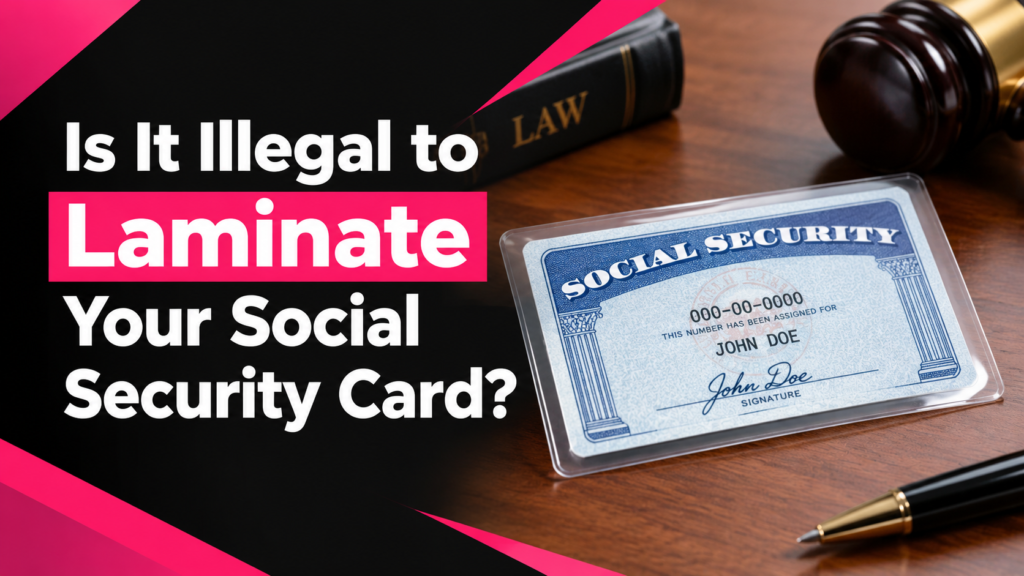

You finally dig out your Social Security card for a new job or a CDL application, only to realize years ago you sealed it in plastic to “keep it safe.” Now you’re wondering if that protective layer just created a bigger problem.
The short answer is clear: is it illegal to laminate your Social Security card? No. But the Social Security Administration strongly advises against it, and a laminated card can cause real headaches with employers, DMVs, and other agencies that need to verify it. This guide explains the official rules, why lamination creates verification issues, what happens if your card is already laminated, and practical ways to protect the card without destroying its usefulness.
The Official Answer from the Social Security Administration
The Social Security Administration (SSA) does not ban lamination under criminal law. No federal statute makes it a crime simply to put your own legitimate card through a laminator. Federal laws that criminalize altering identification documents focus on fraud or intent to deceive, not personal efforts to protect a genuine card from wear.
Still, the SSA’s public guidance is unambiguous. On its official FAQ page, the agency states: “Do not laminate your card. Lamination prevents detection of many security features. However, you may cover the card with plastic or other removable material if it does not damage the card.”
That same warning appears on the perforated stub that comes with every new card and in the SSA’s internal procedures. Agency staff are instructed to tell applicants that the SSA “cannot guarantee the validity of a card that has been laminated.” In short, while you will not face arrest for laminating the card, you may face rejection when you try to use it.
Why the SSA Discourages Lamination: Security Features and Anti-Counterfeiting Measures
Social Security cards issued after October 31, 1983, are printed on specialized banknote-quality paper designed to resist counterfeiting. The SSA incorporates multiple security features and anti-counterfeiting measures so that employers, government agencies, and others can confirm a card is genuine.
These features include specialized paper with a distinctive feel and appearance, raised printing, planchettes (small colored discs embedded in the paper), and other elements that can be checked by touch, by tilting the card, or under certain lighting. Permanent plastic lamination covers or alters these features. Once the plastic is bonded to the card, many of the checks become difficult or impossible. That is exactly why the SSA tells people not to laminate.
The goal is not to make the card fragile. It is to keep the document’s authenticity verifiable. When those security features are hidden, the card loses much of its practical value for official purposes, even though the underlying Social Security number remains the same.
Can an Employer Reject a Laminated Social Security Card?
Yes. For employment verification on Form I-9, an unrestricted Social Security card is a List C document that shows work authorization. Current U.S. Citizenship and Immigration Services (USCIS) guidance is explicit: the card must not be laminated.
Employers following the Handbook for Employers (M-274) and the official Lists of Acceptable Documents will reject a laminated card. This is not optional for careful HR departments. A laminated card fails the requirement that the document appear genuine and relate to the person presenting it in a way that allows proper examination of its features.
If you present a laminated card during the Form I-9 process, the employer can (and often will) ask you to provide a different acceptable document from List A or a combination of List B and List C documents. You may also present a receipt for a replacement Social Security card as a temporary measure while waiting for the new card to arrive.
The same rejection risk can appear in other settings that require proof of your Social Security number, such as certain state driver’s license applications or benefit claims. Employer acceptance is not guaranteed once the card is permanently sealed in plastic.
What Happens If You Already Laminated Your Social Security Card?
Your Social Security number itself is unaffected. The number remains valid for tax, benefit, and identification purposes. The problem is limited to the physical card.
If the laminated card is rejected, the practical solution is to request a free replacement. The SSA will issue a new card. In many cases you can start the process online through a my Social Security account if you meet the eligibility criteria (generally U.S. citizens age 18 or older who are not changing name or other identifying information). Otherwise you apply in person at a local Social Security office using Form SS-5 and the required identity documents.
SSA policy notes that if a replacement is requested for a laminated card, the applicant should return the laminated card. The agency does not routinely push people to replace a laminated card just because it is laminated, but once you decide you need a usable card, returning the old one is part of the process. Replacement cards are free, and there are lifetime limits on the number of replacements you can receive (generally three per year and ten in a lifetime, with exceptions for name changes or certain other situations).
Until the new card arrives, keep the receipt. That receipt can serve as a temporary stand-in for Form I-9 purposes in many cases.
How to Protect Your Social Security Card Without Laminating
The SSA explicitly allows a better approach: cover the card with plastic or another removable material that does not damage it. A clear plastic sleeve, a small zip-top bag, or a cardholder designed for important documents works well. The card stays clean and protected from moisture and creasing, yet anyone who needs to inspect it can remove the cover and examine the original paper and printing.
Beyond the physical covering, good habits matter more than any sleeve:
- Store the card in a secure place at home with other important papers rather than carrying it daily. The SSA repeatedly notes that the card is not an everyday identification document and that you usually only need to show it to a new employer.
- Memorize the number or keep it in a secure password manager so you do not need the physical card for routine matters.
- Avoid making unnecessary photocopies or digital images that could be stolen.
- Consider the digital options available through a my Social Security account for viewing your number when a physical card is not required.
These steps give you official document protection without compromising the card’s usability or its tamper detection features.
Practical Scenarios Where a Laminated Card Causes Trouble
Job applicants and workers completing Form I-9 are the most common group affected. A hiring manager who follows USCIS rules will not accept the laminated card as a List C document. You then scramble for another acceptable document or wait for a replacement.
CDL drivers and others who must present the card for licensing or background checks can face similar delays. Some state motor vehicle agencies treat the Social Security card as supporting proof of the number and may decline a laminated version if they cannot verify its features.
Even informal situations, such as opening certain financial accounts or applying for government benefits, can stall if the reviewing official questions the card’s authenticity. In each case the underlying number is fine, but the physical document is compromised.
Step-by-Step: How to Replace a Laminated Social Security Card
- Determine whether you can apply online. Create or sign in to a my Social Security account at ssa.gov and check the replacement options. Many U.S. citizens age 18 or older with a U.S. mailing address can complete the process online without mailing documents.
- If online is not available or you are changing other information, complete Form SS-5 and gather original or certified documents that prove your identity and citizenship or immigration status.
- Submit the application and, when requested, return the laminated card.
- Wait for the new card to arrive by mail, typically within 10 to 14 business days after processing.
- Place the new card in a removable protective sleeve and store it securely.
Throughout the process, remember that replacement is free. There is no fee for a standard Social Security card.
Common Misconceptions About Laminating the Card
Some people believe older cards (issued before certain security upgrades) can be laminated without issue. The SSA’s advice does not distinguish by age of the card in this way. The guidance applies broadly.
Others assume that because the number is what matters, the physical condition of the card is irrelevant. For Form I-9 and many other official uses, the physical card’s condition does matter.
A final misconception is that any plastic covering is the same as lamination. Removable covers are specifically allowed. Permanent bonding of plastic to the paper is the problem.
Frequently Asked Questions
Is it illegal to laminate your Social Security card?
No. There is no federal criminal statute that makes personal lamination of your own genuine card illegal. The SSA strongly discourages it because it interferes with security features.
Can an employer reject a laminated Social Security card for Form I-9?
Yes. Current USCIS guidance states that a Social Security card used as a List C document must not be laminated. Employers following the rules will reject it.
Is a laminated Social Security card still valid?
The number remains valid. The physical card, however, may be rejected for employment verification and other purposes that require inspection of the original document.
How do I protect my Social Security card without laminating it?
Use a clear, removable plastic sleeve or similar cover that does not damage the card. Store the card in a safe place at home rather than carrying it daily.
How do I replace a laminated Social Security card?
Request a free replacement online through my Social Security if you qualify, or apply in person with Form SS-5. Return the laminated card when asked. The new card is free.
What security features does lamination hide?
Specialized paper quality, raised printing, embedded planchettes, and other anti-counterfeiting elements that can be checked by touch or visual inspection become difficult or impossible to examine under permanent plastic.
Do I need to carry my Social Security card every day?
No. The SSA advises against routine carrying. Keep it secure at home and present it only when specifically required, such as for a new employer’s Form I-9.
You May Also Like: Abbreviation for a Lawyer: Atty., Esq., and J.D. Explained