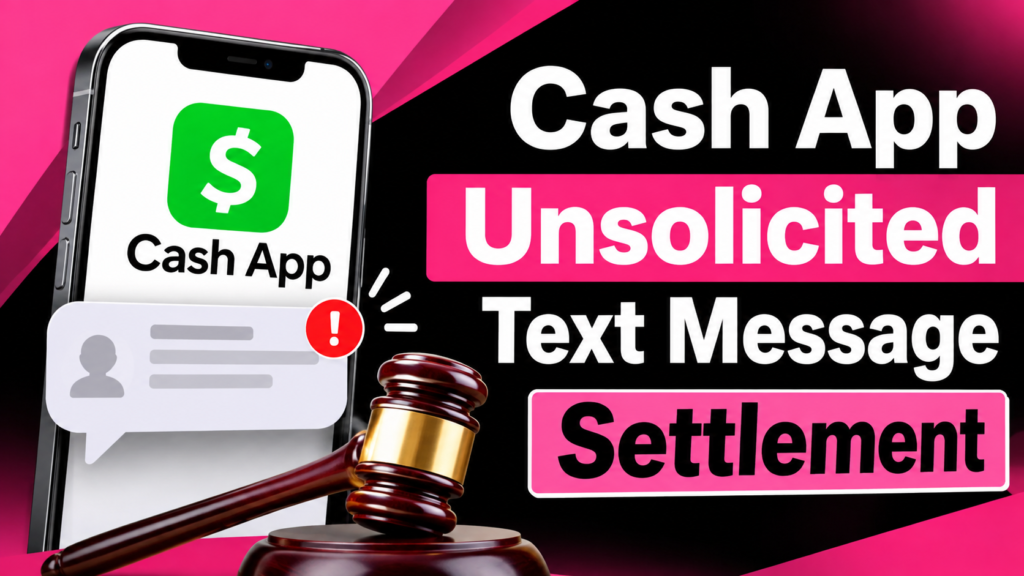

Did you ever get a random Cash App referral text that felt like spam? Thousands of Washington residents did, and a $12.5 million class action settlement addressed those messages. This cash app unsolicited text message settlement (Bottoms v. Block, Inc.) resolved claims that Block, Inc., the parent company of Cash App, helped flood people with unwanted “Invite Friends” texts.
In this guide, you will find clear details on who qualified, how much approved claimants received, important court dates, and how to check your status if you filed a claim. The claim window closed long ago, but understanding the outcome still matters for consumers tracking similar cases or their own payment history.
What the Cash App Unsolicited Text Message Settlement Was About
Cash App’s “Invite Friends” feature let existing users send pre-written referral texts to contacts in their phones. Users could earn a $5 bonus when someone signed up with their code. A typical message promoted Cash App and offered the recipient money for joining.
Plaintiffs argued these were commercial electronic text messages sent without the recipients’ clear, advance consent. Kimberly Bottoms, a Washington resident, received such a text and sued. The lawsuit claimed Block substantially assisted users in transmitting these messages in violation of Washington’s Commercial Electronic Mail Act (CEMA) and the Washington Consumer Protection Act (CPA).
Block denied any wrongdoing and maintained it complied with the law. The company agreed to settle rather than continue the fight. The settlement did not include an admission of liability.
Roughly 1.975 million phone numbers with Washington area codes received these texts during the relevant period, according to data provided in the case. Notices went out by email and postcard in 2025. The Washington Attorney General intervened to support the state’s consumer protection laws.
Key Case Details at a Glance
- Case name: Bottoms v. Block, Inc.
- Case number: 2:23-cv-01969 (U.S. District Court, Western District of Washington)
- Settlement amount: $12.5 million
- Final approval date: December 2, 2025
- Claim deadline: October 27, 2025 (closed)
This was primarily a state-law case under CEMA and the CPA, not a federal TCPA class action, though the issues around unsolicited commercial texts overlap with TCPA concerns that appear in many similar lawsuits.
Who Was Eligible for the Settlement
Eligibility was narrow and specific. You had to meet all three conditions:
- You received at least one Cash App “Invite Friends” referral program text message between November 14, 2019, and August 7, 2025.
- You were a Washington resident at the time you received the text.
- You did not clearly and affirmatively consent in advance to receive that message.
Each person could file only one claim, even if they received multiple texts. Existing Cash App users were not automatically excluded. What mattered was consent to the specific referral message.
Excluded parties included Block employees, officers, directors, counsel, their immediate families, and anyone who timely opted out of the class.
If you lived outside Washington or received the text while living elsewhere, you did not qualify. Residency at the moment of receipt controlled eligibility.
Settlement Fund Breakdown and Payout Amounts
The $12.5 million fund covered several items: payments to approved class members, settlement administration costs, attorneys’ fees, litigation expenses, and a service award for the class representative.
Court records and reports show attorneys’ fees of about $3.1 million and a $10,000 service award to Kimberly Bottoms. Administration costs were estimated in the hundreds of thousands. The remaining net fund went to claimants.
Early estimates projected individual payments of $88 to $147, based on assumptions about claim rates (roughly 5% or less of the potential class). Far fewer people filed valid claims than expected. As a result, the actual payment rose significantly.
Approved claimants received $394.36 each. That figure appears consistently across settlement updates and administrator communications. Payments were non-reversionary, meaning unused funds stayed in the class rather than returning to Block.
How Payments Were Distributed
The settlement administrator, Postlethwaite & Netterville (operating as the Bottoms v. Block Settlement Administrator), began issuing payments on February 2, 2026. Claimants chose from several options on their claim forms:
- PayPal
- Venmo
- Zelle
- Virtual prepaid card
- Paper check
Many digital payments failed or checks were returned. The administrator reprocessed those and reissued paper checks around April 1, 2026. Most reissued checks were expected to arrive by about April 8, 2026. Paper checks remained valid for 120 days. Uncashed funds after that period could be redistributed to successful claimants or directed to a designated cy-près recipient (the Legal Foundation of Washington) if money remained.
Court Timeline and Key Milestones
Understanding the schedule helps put the settlement in context:
- Late 2023: Lawsuit filed by Kimberly Bottoms.
- Case removed to federal court in the Western District of Washington.
- June 30, 2025: Parties reached the $12.5 million settlement agreement after mediation.
- July 29, 2025: Preliminary approval granted.
- August 2025: Class notices distributed.
- October 27, 2025: Deadline to file claims, opt out, or object.
- December 2, 2025: Final approval hearing and order entered by Judge John H. Chun (the case had been reassigned). The court found the settlement fair, reasonable, and adequate.
- February 2, 2026: Payments began.
- Spring 2026: Reissue of failed and returned payments.
By mid-2026 the distribution process was largely complete, with remaining administrative tasks focused on uncashed checks and final accounting.
How to Check Your Claim Status
The claim deadline passed on October 27, 2025. New claims are not accepted. If you filed on time, you can still check status through the official channels.
Visit the settlement website at BottomsTextSettlement.com. Use any claim number or identifying information you received. You may also contact the administrator:
- Phone: 1-877-540-7545
- Email: info@bottomstextsettlement.com (or the address listed on the official site)
- Mail: Bottoms v Block Settlement Administrator, P.O. Box 2631, Baton Rouge, LA 70821
Have your phone number that received the text and any claim confirmation ready. Address updates remain important if you moved after filing. The administrator is not required to keep reissuing checks indefinitely after the initial reissue window.
Practical Tips and Common Pitfalls
Watch for scams. Any unexpected request for fees, bank login details, or new claim forms after the deadline is almost certainly fraudulent. Legitimate settlement communications came from the official website or administrator and never asked for payment to receive money.
If you never received a payment and believe you filed a valid claim, contact the administrator promptly with your documentation. Keep records of your claim submission, confirmation email, and any notices.
This settlement is separate from other Cash App matters, including data-breach class actions and the CFPB enforcement action involving fraud-dispute practices. Payments or notices related to those cases follow different rules and timelines. Do not assume a check or email about one Cash App matter applies to this text-message settlement.
Why Fewer Claims Led to Higher Payouts
Class action administrators often see claim rates well below the total class size. Many people ignore notices, lose track of old texts, or simply decide the estimated amount is not worth the effort. When participation stays low, the same net fund spreads across fewer people and individual awards rise. That is exactly what happened here. The jump from the $88–$147 range to $394.36 reflects that reality. It is a common pattern in consumer settlements involving large potential classes and relatively modest estimated individual recoveries.
Broader Context: Washington Consumer Protection Laws
CEMA regulates commercial electronic mail and text messages sent to Washington residents. It prohibits certain unsolicited commercial messages and treats violations as per se violations of the Consumer Protection Act in many circumstances. The statute gives recipients a private right of action and provides for statutory damages.
Cases involving referral programs and assisted transmission have tested the boundaries of “initiate or assist” language in the law. This settlement resolved one such dispute without a full trial on the merits. Consumers elsewhere should watch how similar state laws treat referral features in payment and social apps.
Frequently Asked Questions
What was the cash app unsolicited text message settlement payout amount?
Approved claimants received $394.36 each after final approval and claim processing.
Can I still file a claim for the Bottoms v. Block settlement?
No. The claim deadline was October 27, 2025. Late claims are not accepted.
Who administered the settlement?
Postlethwaite & Netterville served as the settlement administrator. The official website is BottomsTextSettlement.com.
Was this a TCPA class action?
The case was brought primarily under Washington’s Commercial Electronic Mail Act and Consumer Protection Act. It addressed issues similar to those in federal TCPA cases involving unsolicited commercial texts.
How do I know if my payment was sent?
Check the official settlement website or contact the administrator with your claim information and the phone number that received the text.
What if my digital payment failed or check was returned?
The administrator reissued many failed payments as paper checks in early April 2026. Contact them if you still have not received funds and filed a timely claim.
Does living in Washington now matter if I received the text while living elsewhere?
No. Residency at the time you received the text controlled eligibility.
You May Also Like: Cash App Settlement Eligibility: Payouts, Deadlines, and Requirements