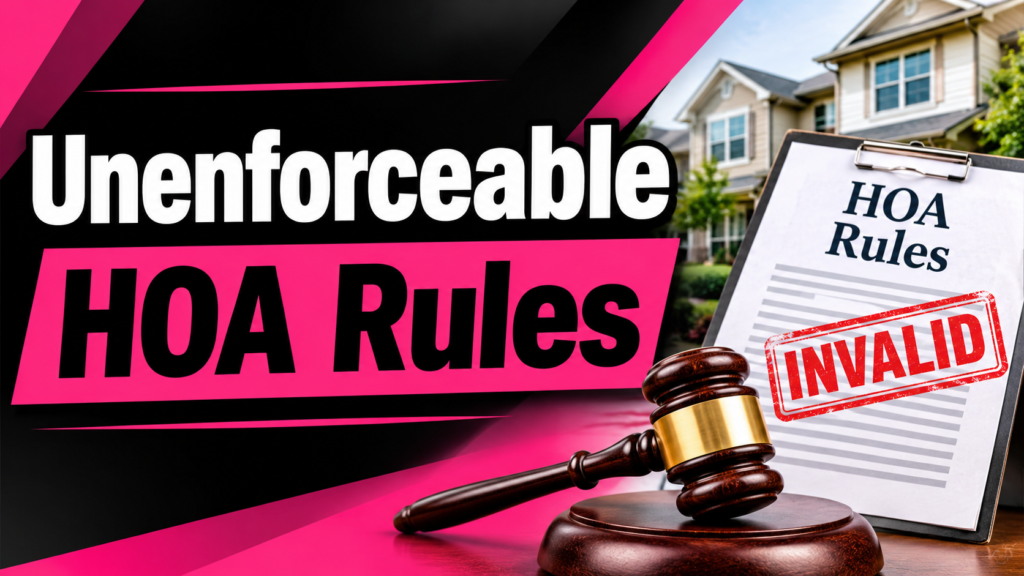

Imagine opening a letter from your homeowners association that fines you $200 for a satellite dish on your patio or demands you take down the American flag flying outside your front door. You followed the community guidelines as best you could, yet the board insists the rule is ironclad. The truth is, not every HOA rule holds up under the law. Many so-called unenforceable HOA rules conflict with higher authority and simply cannot be enforced, no matter what your covenants say.
This guide walks homeowners, prospective buyers, and condo owners through the legal boundaries of HOA power. You will learn how federal statutes, state HOA laws, and basic principles of fairness limit what boards can demand. More importantly, you will gain practical steps to recognize overreach and push back effectively. Understanding these limits protects your property rights and helps create fairer communities for everyone.
Understanding the Hierarchy of HOA Authority
Every HOA rule sits inside a clear legal ranking. Federal law sits at the top. State statutes and local ordinances come next. Below those sit the recorded covenants, conditions and restrictions (CC&Rs), then the bylaws, and finally any board-adopted rules or regulations.
When a lower-level rule conflicts with a higher one, the higher law controls. An HOA cannot enforce a provision that violates federal or state law, even if the language appears in the original CC&Rs and every owner signed off on it years ago. Courts routinely treat such conflicts as rendering the community rule void and unenforceable.
This hierarchy exists because HOAs are private associations created under state law. They do not possess sovereign power. Their authority flows from the governing documents and from the statutes that authorize them. Boards that ignore this ranking risk fines, lawsuits, and loss of credibility with owners.
Federal Laws That Override HOA Rules
Several federal protections apply nationwide and leave little room for HOA deviation. These laws form the strongest category of unenforceable HOA rules.
Fair Housing Act Protections
The Fair Housing Act (42 U.S.C. § 3601 et seq.) prohibits discrimination in housing based on race, color, national origin, religion, sex, familial status, or disability. HOAs fall squarely under its coverage. Any rule, policy, or enforcement practice that treats people differently because of a protected characteristic is illegal.
Common violations include blanket bans on children using the pool or playground after certain hours, occupancy limits written to discourage families, or refusal to allow reasonable modifications for residents with disabilities. Rules that appear neutral on their face can still violate the Act if they have a discriminatory effect or if the board enforces them selectively against members of a protected class.
Service animals and emotional support animals receive special protection. A no-pets covenant cannot override a legitimate request for an assistance animal when the animal is necessary for a person with a disability to use and enjoy the home. Boards must consider reasonable accommodation requests and cannot demand excessive documentation or impose extra fees in most cases. For official guidance, review the U.S. Department of Housing and Urban Development resources at hud.gov.
Freedom to Display the American Flag Act
The Freedom to Display the American Flag Act of 2005 specifically addresses condominium associations, cooperative associations, and residential real estate management associations. It states that these entities may not adopt or enforce any policy that restricts or prevents a member from displaying the United States flag on residential property the member owns or has the exclusive right to possess or use.
Boards retain limited authority to impose reasonable time, place, and manner restrictions necessary to protect a substantial interest of the association. They may regulate flag size, require proper mounting, or limit the number of flags. They cannot ban the flag outright or demand its removal simply because it conflicts with aesthetic preferences. Many states reinforce this federal protection with their own flag display statutes.
Over-the-Air Reception Devices Rule
The Federal Communications Commission’s Over-the-Air Reception Devices Rule (47 C.F.R. § 1.4000), commonly called the OTARD rule, has protected certain antennas and satellite dishes since 1996. HOAs cannot enforce restrictions that unreasonably delay installation, unreasonably increase cost, or prevent reception of an acceptable quality signal for covered devices.
Covered equipment generally includes satellite dishes one meter (about 39 inches) or less in diameter, television broadcast antennas, and certain fixed wireless antennas, along with the masts that support them. The protection applies to areas within the exclusive use or control of the owner, such as a balcony, patio, or yard. Associations may still impose safety-based limits if those limits apply equally to comparable fixtures, but outright bans or placement rules that effectively kill signal quality are preempted. Full details appear on the FCC website at fcc.gov.
These three federal frameworks alone invalidate many rules still written into older CC&Rs. Boards that continue to enforce them expose the association to liability.
State Laws That Limit HOA Power
Beyond federal preemption, nearly every state has enacted statutes that further constrain HOA authority. These laws vary widely, so homeowners must check their specific jurisdiction. Common protections include:
- Solar energy systems. More than thirty states void or severely limit covenants that prohibit or effectively restrict solar panel installation. Many set numerical thresholds: restrictions that reduce efficiency by more than 10 percent or increase costs beyond a stated amount are often unenforceable. Boards may still regulate appearance and placement within those limits.
- Clotheslines and outdoor drying. Roughly nineteen states have right-to-dry laws that protect energy-efficient outdoor drying. A pure aesthetic ban on clotheslines frequently fails in those jurisdictions.
- Political signs. A significant number of states protect noncommercial or political yard signs during election periods or year-round, subject to reasonable size and placement rules. California Civil Code section 4710 and Arizona Revised Statutes section 33-1808 offer clear examples. No federal free-speech protection applies to private associations in the same way it does to government, so state statutes and the governing documents control.
- Electric vehicle charging stations. Growing numbers of states require associations to allow reasonable installation of EV chargers, often with cost-sharing or placement guidelines.
- Landscaping and drought-tolerant plants. Several states, including California and Florida, protect certain environmentally friendly landscaping choices from pure aesthetic bans.
Always cross-check the current version of your state’s common-interest community or condominium act. Statutes change, and recent amendments can quietly invalidate older community rules.
Selective Enforcement and Arbitrary Application
Even a facially valid rule can become unenforceable through selective enforcement. When a board applies a restriction against one owner while ignoring identical or similar violations by others, courts in many states treat the enforcement action as arbitrary or as a waiver of the right to enforce that particular restriction against the targeted owner.
To succeed with this defense, homeowners usually need documented evidence: photographs of comparable violations with dates and locations, records of complaints the board received and ignored, and proof that the association knew or should have known about the other breaches. Requesting official records under state inspection statutes often yields meeting minutes, violation logs, and correspondence that strengthen the case.
Selective enforcement carries extra risk when it tracks a protected characteristic under the Fair Housing Act. In those situations, the homeowner may file a complaint with HUD in addition to any internal or state-court challenge.
Rules Adopted Without Proper Procedure
HOA boards must follow the procedures set out in the governing documents and state law when they create or amend rules. Failure to provide required notice, achieve a proper quorum, or obtain the necessary owner vote can render a new rule unenforceable.
Many states also impose due-process requirements before fines can be levied: written notice of the alleged violation, an opportunity to be heard, and a written decision. Discipline imposed without these steps is often ineffective. Homeowners should review both the bylaws and the applicable state statute for exact notice periods and hearing rights.
Vague standards create another vulnerability. Rules that simply require property to remain “neat and attractive” or “in harmony with the neighborhood” without objective criteria invite challenges on grounds of arbitrariness.
Common Examples of Unenforceable HOA Rules
Real-world scenarios help illustrate the principles:
- A board cites an owner for installing a 36-inch satellite dish on a private balcony. The OTARD rule almost certainly protects the installation.
- An association demands removal of an American flag flown from a wall-mounted holder on the owner’s exclusive-use patio. The Freedom to Display the American Flag Act overrides the ban.
- A “no children in the pool after 6 p.m.” rule is applied only to families while adult-only gatherings continue later. Familial-status protections under the Fair Housing Act may be violated.
- An older CC&R provision bans all solar panels. In states with solar-access statutes, the ban is void.
- The board fines one owner for a political yard sign during an election window while ignoring identical signs on neighboring lots. Selective enforcement and any applicable state sign statute both undermine the action.
- A blanket no-pets rule is used to force removal of a verified service animal. The Fair Housing Act requires consideration of a reasonable accommodation.
These examples appear repeatedly in homeowner complaints and court records. Boards sometimes continue enforcing outdated language because it remains in the recorded documents, yet that language carries no legal force once higher law intervenes.
How to Challenge Unenforceable HOA Rules
Homeowners who believe a rule is invalid should proceed methodically. Rushing into confrontation or litigation rarely produces the best outcome.
- Gather the governing documents. Obtain the current CC&Rs, bylaws, articles of incorporation, and any board-adopted rules. Confirm the exact language the board relies on.
- Research the higher law. Identify the specific federal statute, FCC rule, or state code section that conflicts with the community rule. Print or save the official text.
- Document everything. Save every violation notice, email, letter, and photograph. If selective enforcement is an issue, systematically record comparable conditions elsewhere in the community.
- Request records. Most states give owners a statutory right to inspect association books and records. Use that right to obtain enforcement history, meeting minutes, and correspondence related to the rule.
- Send a written challenge. Address the board or management company by certified mail or email with delivery confirmation. Cite the specific rule and the higher authority that makes it unenforceable. Request written confirmation that the board will cease enforcement against you.
- Use internal dispute resolution. Many governing documents and state statutes require or encourage mediation or alternative dispute resolution before formal litigation. Participate in good faith.
- Escalate when necessary. File a complaint with HUD for Fair Housing Act issues, with the FCC for OTARD violations, or with the state agency that oversees HOAs if one exists. As a last resort, consult an attorney experienced in community association law about a declaratory judgment action or defense against fines and liens.
Throughout the process, maintain a professional tone. Boards sometimes reverse course once they receive a clear, well-supported legal citation. Escalating the dispute publicly or emotionally can harden positions and complicate resolution.
Practical Tips for Prospective Buyers
Anyone considering a purchase in an HOA community should review the governing documents before closing. Look specifically for:
- Outdated technology restrictions that conflict with the OTARD rule
- Absolute bans on flags, solar systems, or political signs
- Occupancy or amenity rules that may raise Fair Housing Act concerns
- Fine schedules or enforcement procedures that ignore state due-process requirements
Ask the seller or the association for a current set of rules and any pending amendments. Speak with current residents about enforcement patterns. A community that aggressively polices minor aesthetic issues while ignoring more serious violations may signal selective enforcement problems down the road.
Pitfalls Homeowners Should Avoid
Several common mistakes weaken otherwise strong challenges:
- Ignoring internal deadlines for hearings or appeals. Missing a procedural window can forfeit rights even when the underlying rule is invalid.
- Relying solely on internet summaries instead of the official statute or regulation text.
- Failing to document comparable violations when claiming selective enforcement.
- Withholding assessment payments as a form of protest. Most states treat unpaid assessments as collectible regardless of pending disputes over rules, and nonpayment can lead to liens or foreclosure.
- Assuming every board action is malicious. Many directors are volunteers who simply follow the documents they inherited. A clear, calm explanation of the law often resolves the issue without further escalation.
The Role of HOA Board Authority and Homeowner Rights
Boards hold fiduciary duties to the association and its members. They must act in good faith, within the scope of their authority, and in a manner that is not arbitrary or capricious. Homeowners retain corresponding rights: the right to inspect records, the right to fair procedures before discipline, and the right to insist that rules comply with higher law.
When boards overstep, the legal rights of homeowners include both defensive tools (challenging fines and liens) and affirmative tools (seeking declaratory relief or, in appropriate cases, damages). Knowing these rights shifts the power dynamic. An informed owner is far less likely to accept an unlawful demand simply because the board issued it on official letterhead.
Conclusion
Unenforceable HOA rules exist because community associations operate inside a larger legal framework they cannot rewrite. Federal protections for fair housing, American flags, and over-the-air reception devices, combined with state statutes on solar access, political expression, and due process, place firm limits on board power. Selective enforcement and procedural shortcuts further undermine otherwise valid restrictions.
Armed with the hierarchy of authority, concrete examples, and a clear challenge process, homeowners can identify overreach and respond effectively. Start by reviewing your governing documents against the higher laws that apply in your state. Document carefully, communicate in writing, and escalate only as needed. Fair communities depend on boards that respect legal boundaries and owners who insist on them. If your situation involves complex facts or significant financial stakes, consult a qualified attorney familiar with community association law in your jurisdiction to evaluate the strongest path forward.
Frequently Asked Questions
What makes an HOA rule unenforceable?
A rule becomes unenforceable when it conflicts with federal or state law, was adopted without required procedures, is applied selectively, or is so vague that it invites arbitrary enforcement. Higher law always controls.
Can an HOA fine you for unenforceable rules?
Boards sometimes issue fines anyway, but those fines are vulnerable to challenge. Paying under protest while documenting the legal defect preserves your ability to seek refund or cancellation later.
How do I report unenforceable HOA rules?
Begin with a written notice to the board. For Fair Housing Act issues, file with HUD. For satellite dish disputes, contact the FCC. Some states maintain HOA oversight agencies that accept complaints.
Can HOAs restrict satellite dishes?
Under the OTARD rule, HOAs generally cannot ban dishes one meter or smaller on exclusive-use property or impose restrictions that unreasonably impair installation or signal quality.
What are examples of illegal HOA rules?
Outright bans on U.S. flags, satellite dishes under one meter, service animals required for disabilities, and (in many states) solar panels or political signs during protected periods often qualify as illegal or unenforceable.
How do I challenge HOA covenants?
Review the documents, cite the conflicting higher law in writing, document selective enforcement if present, use internal dispute resolution, and escalate to regulators or court if necessary.
Do federal laws always override HOA rules?
Yes, in the specific areas those laws address. The Supremacy Clause and the statutes themselves make federal protections superior to private covenants.
You May Also Like: What Happens If You Don’t File Your Taxes But Don’t Owe Anything to the IRS?