
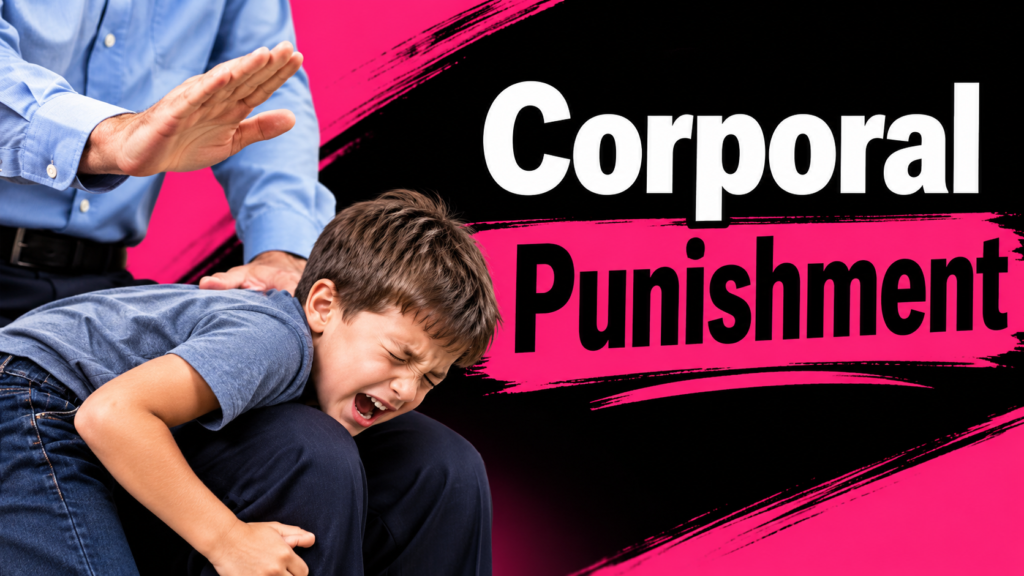

Nearly 1.2 billion children worldwide experience corporal punishment at home each year, according to the World Health Organization. Many parents and educators still view physical discipline as a normal or even necessary part of raising children. Yet decades of research paint a different picture: one of elevated risks to mental health, behavior, and long-term development, with no clear benefits.
This guide explains what corporal punishment is, summarizes the psychological and developmental effects, reviews legal frameworks in the United States and globally, and outlines research-backed alternatives rooted in positive discipline. It is written for parents, educators, child advocates, policymakers, and mental health professionals who want clear, evidence-based information to support healthier approaches to guidance and child abuse prevention.
What Constitutes Corporal Punishment?
Corporal punishment, also called physical discipline or physical punishment, is any punishment that uses physical force and is intended to cause some degree of pain or discomfort, however light. The United Nations Committee on the Rights of the Child provides this widely accepted definition.
It most often involves hitting a child with a hand (smacking, slapping, or spanking) or an implement such as a belt, wooden spoon, or paddle. Other forms include kicking, shaking, pinching, pulling hair, forcing a child into uncomfortable positions, or similar acts meant to cause pain or discomfort as a response to behavior.
Physical discipline is distinct from physical abuse in legal terms in many places, yet the line can be thin. Research shows that most cases of physical abuse begin as acts of intentional corporal punishment that escalate. The intent may be corrective, but the method relies on pain or the threat of pain.
In homes, schools, and other settings, corporal punishment remains one of the most common forms of violence against children. Understanding the definition is the first step toward evaluating its place in modern parenting and education.
Psychological Consequences of Corporal Punishment
The effects of corporal punishment on children extend far beyond the moment of impact. Longitudinal studies and meta-analyses consistently link physical discipline to a range of negative outcomes in childhood and adulthood.
Children who experience corporal punishment show higher rates of externalizing behaviors such as aggression, defiance, and antisocial conduct over time. Rather than teaching self-control, the practice often models the idea that physical force resolves conflict. This can increase the very behaviors parents hope to reduce.
Internalizing problems also rise. These include anxiety, depression, low self-esteem, and emotional instability. Some research points to atypical brain development and elevated risk of mental health challenges that persist into adulthood, including higher rates of substance use and suicidal ideation.
Cognitive and socio-emotional development can suffer as well. Studies across multiple countries find that children exposed to corporal punishment are less likely to be developmentally on track. Academic performance and the quality of the parent-child relationship often decline. Trust erodes when a primary caregiver becomes a source of fear or pain.
Childhood trauma is another concern. Even “mild” physical discipline can contribute to cumulative stress that affects stress-response systems and later health. Indirect physical harm appears in some long-term data, including associations with higher rates of certain chronic conditions in adulthood.
Importantly, no high-quality studies have found lasting positive effects on behavior, moral development, or well-being. Short-term compliance may occur, but it comes at a cost and does not build the internal regulation children need.
The American Psychological Association’s 2019 Resolution on Physical Discipline of Children by Parents reflects this evidence. APA recognizes that scientific findings demonstrate negative effects on mental health and development and recommends alternative forms of discipline associated with better outcomes.
Research on Behavioral Outcomes and Child Development
A large body of developmental psychology research underpins these conclusions. Prospective longitudinal studies, which follow children over time, are especially informative because they help address questions of causation and directionality.
A narrative review of 69 prospective studies published in The Lancet found that physical punishment consistently predicts increases in child behavior problems. It is not associated with positive outcomes over time. It raises the risk of involvement with child protective services. Associations hold across child and parent characteristics, including race, gender, and socioeconomic status.
Meta-analyses of spanking specifically reach similar conclusions. One major review of 111 effect sizes involving more than 160,000 children found that spanking was linked to higher risk of detrimental outcomes in 13 of 17 categories examined. These included aggression, antisocial behavior, mental health problems, and poorer parent-child relationships. Effect sizes did not differ substantially from those associated with more severe physical abuse in many analyses.
Research in low- and middle-income countries confirms the pattern. A recent multilevel meta-analysis covering dozens of nations found consistent associations with worse mental health, impaired social-emotional development, negative academic outcomes, and heightened externalizing problems.
Critics sometimes argue that difficult children elicit more physical discipline, creating a reverse-causation problem. While externalizing behavior can increase the likelihood of physical responses, longitudinal designs that control for baseline behavior still show that physical punishment predicts worsening outcomes later. Quasi-experimental approaches reinforce this direction of effect.
The consensus among major health organizations is clear: corporal punishment carries multiple risks of harm and offers no benefits for children, parents, or societies. The World Health Organization’s 2025 technical report on the public health impact of corporal punishment underscores this point with global data.
Legal Status of Corporal Punishment
Laws governing corporal punishment vary widely by country and, within the United States, by state and setting.
Global Picture
As of recent counts, approximately 70 countries have prohibited all corporal punishment of children in every setting, including the home. Sweden led the way in 1979. Many European nations followed, along with countries in Latin America, Africa, and Asia. Progress continues, with additional states committing to full bans.
These laws aim to give children the same legal protection from assault that adults receive. They serve an educational function as much as a punitive one, clarifying that violence is not an acceptable tool of childrearing. Evidence shows that bans alone do not instantly eliminate the practice, but they form a foundation for changing social norms when paired with parenting support and public education.
In schools, more than 100 countries have banned corporal punishment. Prevalence remains high in some regions, particularly parts of Africa, Central America, and South Asia.
United States: Homes and Schools
In the United States, corporal punishment by parents remains legal in all 50 states under the concept of “reasonable” parental discipline or privilege. Courts generally allow physical force for correction as long as it does not cross into abuse, defined by injury, excessive force, or other factors that vary by jurisdiction. No state has enacted a complete ban on parental spanking.
The picture is different in schools. The 1977 Supreme Court decision in Ingraham v. Wright held that the Eighth Amendment’s ban on cruel and unusual punishment does not apply to disciplinary corporal punishment in public schools, and that the Fourteenth Amendment does not require a hearing before paddling. This left regulation to the states.
Today, roughly 32 or 33 states plus the District of Columbia prohibit corporal punishment in public schools. Approximately 17 to 19 states still permit it, concentrated largely in the South and parts of the Midwest. Even in states where it is legal, many individual districts ban the practice. Private schools face fewer restrictions in most places.
Federal data show that tens of thousands of students still experience school corporal punishment in a given year, with disproportionate impact on Black students and students with disabilities. Major organizations, including the American Academy of Pediatrics and the American Psychological Association, oppose the practice in educational settings.
Legal status continues to evolve. Some states have tightened rules in recent years, and advocacy for broader bans persists at both state and federal levels.
Why Corporal Punishment Is Ineffective
Parents often turn to physical discipline because it produces immediate compliance or because it mirrors how they were raised. Research shows these short-term gains do not translate into long-term improvements.
Physical punishment does not teach children the reasons behind rules or help them develop internal moral standards. It focuses attention on avoiding pain rather than understanding impact or making better choices. Children may learn to hide behavior rather than change it.
Modeling is powerful. When caregivers use force, children learn that aggression is an acceptable way to influence others. This contributes to higher rates of aggression in peer relationships and, later, in adult relationships.
The practice also risks escalation. What begins as a spank can become more severe when frustration rises or when the child does not respond as expected. Involvement with child protective services increases with reliance on physical methods.
Finally, it damages the secure attachment that supports healthy development. Fear and pain from a trusted adult undermine the sense of safety children need to explore, learn, and regulate emotions.
These reasons explain why leading bodies in developmental psychology and public health recommend moving away from physical discipline entirely.
Alternatives to Corporal Punishment in Parenting
Positive discipline offers effective, research-supported ways to guide behavior while preserving the parent-child relationship. The goal is teaching, not punishing. Core principles include connection, clear expectations, natural and logical consequences, and problem-solving.
Practical strategies include:
- Focus on prevention and environment. Childproof spaces, offer age-appropriate activities, and meet basic needs for food, rest, and attention so fewer power struggles arise.
- Set clear, consistent expectations. Explain rules in simple language and involve children in creating family agreements when possible.
- Use natural and logical consequences. If a child refuses a coat, they feel cold (natural). If they leave toys out, the toys are put away for a time (logical and related).
- Offer choices. “Would you like to put on your shoes first or your jacket?” gives a sense of control while moving toward the goal.
- Catch positive behavior. Specific praise for cooperation and effort reinforces what you want to see more of.
- Validate feelings while holding limits. “You’re really angry that playtime is over. It’s okay to feel that way, and we still need to clean up now.”
- Model the behavior you want. Children learn self-regulation by watching adults handle frustration calmly.
- Problem-solve together. For older children, ask what they think would help next time and brainstorm solutions.
- Take breaks when needed. Parents who feel overwhelmed can step away briefly to regain calm rather than reacting in the moment.
- Seek support. Parenting programs, books grounded in evidence, and guidance from pediatricians or therapists can build skills.
These approaches take practice and consistency. They often require more time in the short term than a quick physical response, yet they build skills that last. Organizations such as the American Academy of Pediatrics and the CDC promote similar non-violent strategies through resources on positive parenting.
In schools, positive behavior support systems, restorative practices, and social-emotional learning curricula provide structured alternatives that improve climate and reduce reliance on punitive methods.
Supporting Child Abuse Prevention and Policy Change
Ending reliance on corporal punishment supports broader child abuse prevention efforts. When society treats physical force against children as unacceptable, the threshold for recognizing and intervening in more severe harm becomes clearer.
Policymakers can advance change by supporting full legal bans, funding evidence-based parenting programs, training educators and pediatricians in positive approaches, and collecting better data on prevalence and outcomes. Public awareness campaigns help shift cultural norms so that non-violent methods become the expected standard.
Mental health professionals play a key role by screening for physical discipline practices, educating families about the research, and teaching alternative strategies in a non-judgmental way.
Parents who were raised with corporal punishment may feel conflicted. Acknowledging that history while choosing a different path for the next generation is an act of courage and care. Change is possible at the individual, community, and societal levels.
Conclusion
Corporal punishment remains widespread, yet the evidence shows it is ineffective and linked to a range of harms in child development, mental health, and behavioral outcomes. Legal protections lag behind the science in many places, particularly in U.S. homes and some schools. Positive discipline methods offer practical, research-backed alternatives that teach responsibility, strengthen relationships, and support healthy development.
Parents, educators, and advocates can use this knowledge to make informed choices and push for environments where children are guided without violence. For personalized guidance, consult a pediatrician, licensed mental health professional, or evidence-based parenting program in your area. Protecting children from physical punishment is one of the clearest steps we can take toward safer, more supportive childhoods.
Frequently Asked Questions
What is the difference between corporal punishment and child abuse?
Corporal punishment is physical force intended to cause pain or discomfort for disciplinary purposes. Abuse involves more severe injury or harm. Research shows the two exist on a continuum, and physical discipline increases the risk that punishment will escalate into abuse.
Is spanking still legal in the United States?
Yes. Parental spanking remains legal in all 50 states when considered reasonable. Public schools ban it in the majority of states, though it is still permitted in roughly 17 to 19 states.
Does the American Psychological Association support corporal punishment?
No. APA’s 2019 resolution on physical discipline by parents states that scientific evidence demonstrates negative effects and recommends alternative forms of discipline associated with better outcomes for children.
Why do some parents still use physical discipline?
Many were raised with it and view it as normal or effective. Cultural norms, stress, lack of knowledge about alternatives, and the desire for quick compliance also play roles. Education and support can help shift these patterns.
Are there any benefits to corporal punishment?
High-quality research has not identified lasting benefits for behavior, development, or well-being. Any short-term compliance is outweighed by documented risks.
What should I do if I see corporal punishment in a school?
Check your state’s laws and the specific school or district policy. Many districts prohibit it even where state law allows it. You can raise concerns with administrators, school boards, or child advocacy organizations.
How can I start using positive discipline if I was raised with spanking?
Begin with one or two strategies, such as offering choices or using natural consequences. Practice staying calm, seek parenting resources or classes, and be patient with yourself and your child as new habits form. Professional support can accelerate progress.
You May Also Like: How to Choose the Right Family Law Attorney Wheeling WV for Your Divorce or Custody Case