
Running a small business means juggling sales, customers, and cash flow. Legal issues often feel like the last thing you want on your plate. Yet they touch almost every decision you make. Choose the wrong structure and your personal assets sit at risk. Skip a key employment rule and you face fines or lawsuits. Ignore intellectual property and someone else can copy your brand.
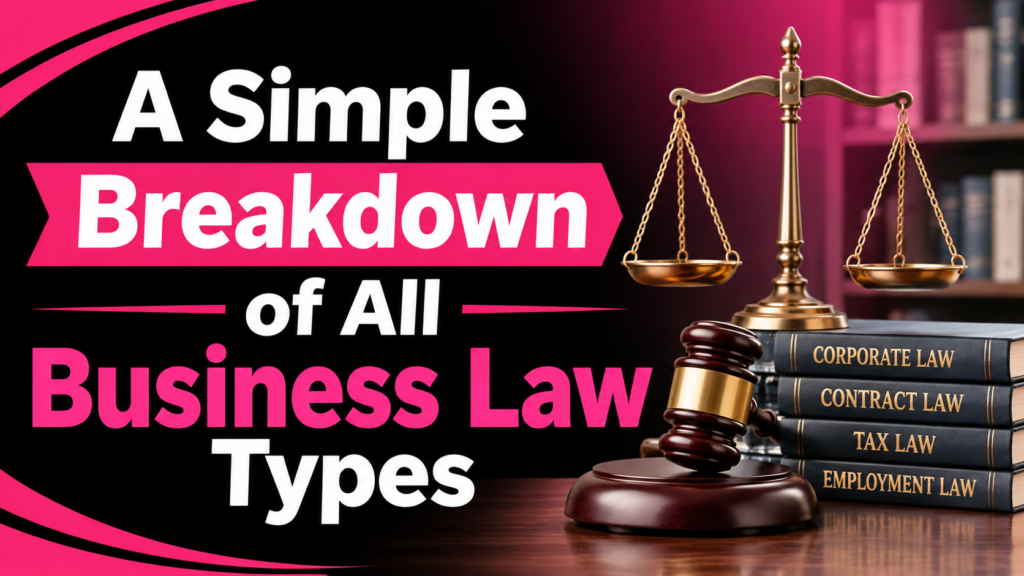
This guide delivers a simple breakdown of all business law types that matter most to entrepreneurs, startup founders, and non-lawyer managers. You will see clear definitions, everyday examples, and practical steps so you can spot risks early, stay compliant, and protect what you are building. No dense jargon. Just the core rules that keep businesses operating smoothly.
What Business Law Actually Covers
Business law is the collection of rules that govern how companies form, operate, hire, sell, pay taxes, and close. It draws from federal statutes, state laws, and local ordinances. Some rules apply nationwide. Others change by state or city.
People sometimes use “business law” and “commercial law” interchangeably. Commercial law focuses more tightly on the buying and selling of goods and the financing of those deals, often guided by the Uniform Commercial Code (UCC). Business law is broader. It includes how you structure the company itself, how you treat employees, how you protect ideas, and how you meet tax and regulatory duties.
Understanding the categories helps you know when to handle something in-house and when to call a lawyer. Most small businesses never need every area at once. You do need a working map of the landscape.
Business Formation and Corporate Governance
The first legal choice you make is the structure of the business. This decision controls personal liability, how profits get taxed, and the paperwork you face each year.
Common Structures Explained
A sole proprietorship is the simplest option. You and the business are the same legal person. Setup costs almost nothing, but creditors can reach your personal savings, home, or car if the business owes money.
A partnership works similarly when two or more people own the company together. General partners share liability. Limited partners can limit their exposure if they stay out of day-to-day management.
A limited liability company (LLC) creates a separate legal entity. Members generally are not personally responsible for business debts, provided they keep personal and business finances separate. Most LLCs enjoy pass-through taxation, meaning profits appear on the owners’ personal returns.
A corporation (C-corp or S-corp) is its own legal person. Shareholders enjoy limited liability. C-corps face corporate-level tax plus tax on dividends (double taxation). S-corps pass income through to shareholders but face ownership limits and stricter formalities.
Corporate governance covers the internal rules that keep the entity legitimate. Corporations must hold meetings, keep minutes, adopt bylaws, and issue stock properly. LLCs usually rely on an operating agreement that spells out ownership percentages, voting rights, and what happens if a member leaves. Skipping these steps can let a court “pierce the veil” and hold owners personally liable.
Practical tip: Open a dedicated business bank account on day one. Never mix personal and business funds. That single habit protects the liability shield more than almost anything else.
For official guidance on choosing a structure, see the IRS overview of business structures at irs.gov/businesses/small-businesses-self-employed/business-structures.
Contract Law and Contract Enforceability
Contracts form the backbone of commercial transactions. Every supplier deal, customer order, lease, and partnership agreement rests on contract principles.
A valid contract generally needs four elements: a clear offer, acceptance of that offer, consideration (each side gives something of value), and a lawful purpose. Parties must also have the legal capacity to agree.
Written contracts are far safer than handshake deals. They reduce disputes about what was promised. Key clauses often include payment terms, delivery schedules, warranties, limitation of liability, dispute resolution (mediation or arbitration), and termination rights.
The Uniform Commercial Code shapes many sales of goods across states. It supplies default rules on warranties, delivery, and remedies when something goes wrong. Service contracts and employment agreements fall under general common-law principles instead.
Common pitfalls include vague language, missing signatures, or oral modifications that contradict the written terms. Always keep signed copies. If the other side breaches, contract law usually allows you to seek damages that put you in the position you would have occupied if the deal had been performed.
Strong contracts protect both sides. They make relationships clearer and reduce the chance of expensive fights later.
Employment Regulations Every Owner Must Follow
The moment you hire your first employee, a new set of rules applies. Employment regulations cover wages, hours, safety, discrimination, and recordkeeping.
Federal law sets the floor. The Fair Labor Standards Act (FLSA) requires payment of at least the federal minimum wage and overtime at one-and-a-half times the regular rate for most non-exempt employees who work more than 40 hours in a workweek. Many states set higher minimum wages. You must follow the higher rate.
You must correctly classify workers as employees or independent contractors. Misclassification can trigger back taxes, penalties, and unpaid overtime claims. The Department of Labor looks at factors such as control over the work, opportunity for profit or loss, and the permanence of the relationship.
Anti-discrimination laws ban decisions based on race, color, religion, sex, national origin, age (40 and over), disability, and other protected characteristics. The Equal Employment Opportunity Commission enforces many of these rules. Harassment, including a hostile work environment, can create liability even without a formal firing.
Workplace safety falls under the Occupational Safety and Health Act. Employers must provide a workplace free from recognized hazards and may need to post required notices.
Other key areas include Form I-9 verification of work authorization, family and medical leave for covered employers, and proper handling of final paychecks. States often add paid sick leave, predictive scheduling, or pay transparency rules.
Document everything: job descriptions, performance reviews, written policies, and time records. Clear employee handbooks help, but only if you actually follow them.
Resources from the U.S. Department of Labor at dol.gov provide free compliance tools tailored for small businesses.
Intellectual Property Rights That Protect Your Edge
Your brand name, logo, product design, software code, and secret recipes often matter more than physical inventory. Intellectual property rights give you legal tools to stop others from copying those assets.
Trademarks protect names, logos, and slogans that identify your goods or services. Federal registration with the U.S. Patent and Trademark Office (USPTO) strengthens your rights nationwide and puts the public on notice. Common-law rights arise from use, but registration offers stronger remedies.
Patents protect inventions that are new, useful, and non-obvious. Utility patents last 20 years from filing. Design patents protect ornamental designs for shorter periods. The process is technical and often benefits from professional help. Small and micro entities receive significant fee discounts at the USPTO.
Copyrights protect original works of authorship such as software, website content, marketing materials, and product packaging. Protection arises automatically when the work is fixed in a tangible form, but registration is required before you can sue for statutory damages in federal court.
Trade secrets cover confidential business information that gives you a competitive edge, such as customer lists or manufacturing processes. Protection depends on reasonable efforts to keep the information secret (non-disclosure agreements, restricted access, and employee training).
Start early. Search existing trademarks and patents before you invest heavily in a name or product. Use written agreements with employees and contractors that assign ownership of work created for the business to the company.
The USPTO website at uspto.gov offers free tools and guides for small businesses and inventors.
Tax Compliance Basics
Tax rules depend heavily on your chosen structure. Sole proprietors, partners, and most LLC members report business income on their personal returns and pay self-employment tax on net earnings. C-corporations pay tax at the entity level. S-corporations pass income through but must meet strict eligibility rules.
You need an Employer Identification Number (EIN) from the IRS for most entities, hiring, and banking. Sales tax collection depends on whether you have nexus (a sufficient connection) in a state. Online sales and marketplace facilitators have expanded these obligations in recent years.
Employment taxes include Social Security, Medicare, and federal income tax withholding. You must deposit these funds on time and file the required returns. Excise taxes apply to certain products and activities.
Keep clean books. Separate accounts, consistent categorization of expenses, and timely estimated tax payments prevent most problems. The IRS offers free publications and online tools for small businesses. Many owners benefit from a relationship with a CPA who understands both tax law and the chosen entity type.
Consumer Protection and Regulatory Compliance
Customers have legal rights. Consumer protection laws require honest advertising, clear pricing, and safe products. The Federal Trade Commission polices unfair or deceptive practices. State attorneys general enforce similar rules.
Product liability can arise if a product causes injury because of a design defect, manufacturing defect, or inadequate warning. Even small sellers can face claims.
Industry-specific rules add another layer. Food businesses face health department inspections. Financial services face disclosure rules. Online businesses must handle privacy and data security carefully, especially when collecting personal information from residents of states with comprehensive privacy laws.
Regulatory compliance also includes licenses and permits. Some activities require federal licenses. Most need state or local business licenses, zoning approvals, and professional licenses. Check early. Operating without required permits can shut you down and create personal liability in some cases.
The U.S. Small Business Administration site at sba.gov walks through registration, licenses, and ongoing compliance steps.
Tort Law and Everyday Liability Risks
Tort law covers civil wrongs that cause harm outside of contracts. The most common for businesses is negligence. If a customer slips on a wet floor you failed to clean or warn about, you may be liable for their injuries.
Premises liability, product liability, and defamation are frequent examples. Insurance (general liability, professional liability, and product liability policies) is the practical first line of defense. Strong safety practices and clear warning signs reduce risk further.
Intentional torts such as fraud or intentional interference with contracts also exist but arise less often in routine operations.
Bankruptcy and Restructuring Options
Even careful businesses can face cash-flow crises. Bankruptcy and restructuring law provides ordered ways to handle unmanageable debt.
Chapter 7 liquidates assets and discharges most debts for eligible debtors. Chapter 11 allows reorganization so the business can keep operating while restructuring obligations. Chapter 13 is mainly for individuals with regular income.
These processes are complex and carry long-term consequences for credit and reputation. Early negotiation with creditors or a formal workout often produces better outcomes than waiting until a filing becomes necessary. Speak with a bankruptcy attorney as soon as serious distress appears.
Practical Steps to Stay Ahead
You do not need to master every statute. You do need a system:
- Choose and maintain the right entity structure.
- Use clear written contracts for important relationships.
- Follow wage, hour, and anti-discrimination rules from day one of hiring.
- Protect your brand and key innovations early.
- Keep clean financial records and meet tax deadlines.
- Carry appropriate insurance and review licenses annually.
- Document decisions and keep personal and business affairs separate.
When a situation feels unfamiliar or high-stakes, consult a qualified attorney or accountant. Early advice almost always costs less than fixing a preventable problem later.
Conclusion
A simple breakdown of all business law types reveals a practical toolkit rather than an overwhelming maze. Formation rules protect your personal assets. Contracts lock in reliable deals. Employment and tax rules keep you compliant. Intellectual property and consumer protections safeguard your reputation and revenue. Tort and bankruptcy frameworks manage the unexpected.
Master the basics that apply to your stage and industry. Build habits around documentation, separation of finances, and timely compliance. That foundation lets you focus on growth instead of constant legal firefighting.
Review your current practices against the categories above. If gaps appear, address them now. For tailored advice, consult a business attorney familiar with your state and industry. Your future self will thank you.
Frequently Asked Questions
What is the difference between business law and commercial law?
Business law is the broader category covering formation, employment, tax, intellectual property, and more. Commercial law focuses more on the sale of goods, financing, and related transactions, often under the Uniform Commercial Code.
Which business structure offers the best liability protection for a small owner?
An LLC or corporation generally shields personal assets from business debts when formalities are observed and finances stay separate. Sole proprietorships and general partnerships do not.
Do I need a lawyer to form an LLC?
Many states allow online filing without a lawyer. An operating agreement and advice on tax elections still benefit most owners. A lawyer can prevent costly drafting mistakes.
How do I know if my worker is an employee or independent contractor?
Look at the degree of control you exercise, whether the worker has opportunity for profit or loss, the permanence of the relationship, and how integral the work is to your business. Misclassification carries serious penalties.
What intellectual property should a new business protect first?
Start with the brand name and logo through trademark searching and registration. Secure copyrights on original content and use non-disclosure agreements to protect trade secrets.
When does a business need to collect sales tax?
You generally must collect sales tax in states where you have nexus, such as a physical presence, employees, or sufficient sales volume under economic nexus rules. Marketplace facilitators often handle collection for platform sales.
Can a small business survive a lawsuit?
Yes. Proper insurance, clear contracts, documented safety practices, and good corporate formalities dramatically reduce both the chance of a suit and the damage if one occurs.
You May Also Like: Alejandro Brito: Florida Commercial Litigator and Founding Partner of Brito PLLC