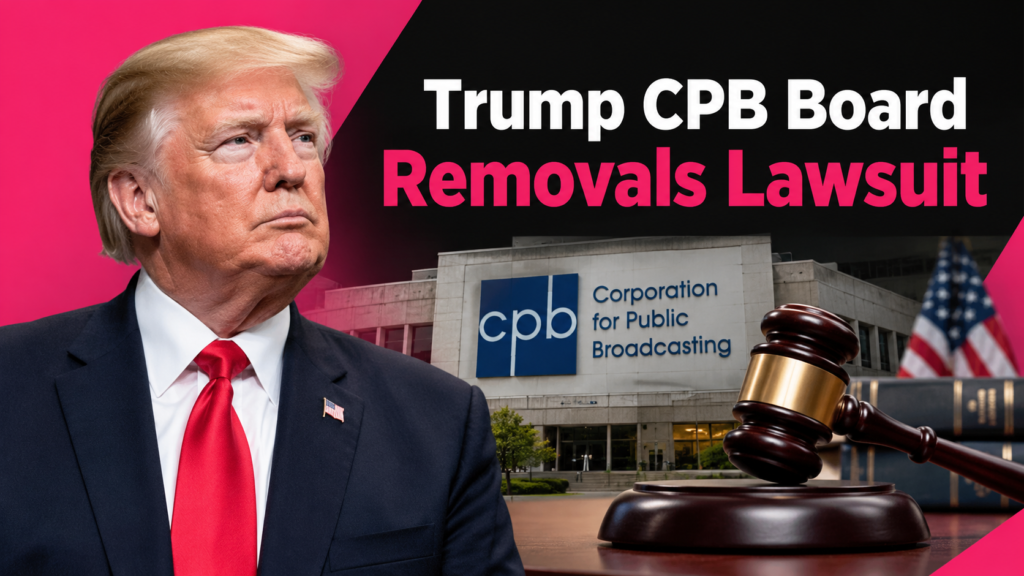

In April 2025, three Corporation for Public Broadcasting board members received terse emails declaring their positions terminated. What followed was a high-stakes legal battle over presidential authority, the independence of public media, and the limits of executive power. The Trump CPB board removals lawsuit never produced a definitive merits ruling on whether the president can fire CPB directors. Instead, broader funding cuts and the corporation’s dissolution rendered the cases moot in January 2026. This article breaks down the timeline, court decisions, statutory framework, and lasting implications for agency governance, PBS and NPR federal funding, and First Amendment media protections.
Readers who follow executive power dynamics, public broadcasting, or federal media regulation will find clear analysis of the Public Broadcasting Act, the Humphrey’s Executor precedent (later reshaped), and what the dispute reveals about congressional design versus presidential claims.
Background: What Is the Corporation for Public Broadcasting?
Congress created the Corporation for Public Broadcasting through the Public Broadcasting Act of 1967. The statute established CPB as a private nonprofit corporation, not an agency or establishment of the United States government. Its purpose was to support noncommercial educational broadcasting while affording “maximum protection from extraneous interference and control.”
CPB distributed hundreds of millions of dollars annually to local public television and radio stations, PBS, and NPR. Board members are appointed by the president with Senate confirmation and serve six-year terms. No more than a majority may belong to the same political party. The statute contains no express “serve at the pleasure of the president” language common to many executive agencies. It also specifies that board members are not employees of the United States.
This design aimed to insulate public media from direct partisan control. Funding flowed through CPB precisely to create distance between the government and content decisions. Critics of public broadcasting long argued the system still reflected progressive bias. Supporters viewed the structure as essential to local journalism, educational programming, and service in underserved communities.
By early 2025 the board had five active directors, all nominated during the prior administration. Removing three would have dropped the board below quorum and halted official business.
The April 2025 Termination Emails and Immediate Lawsuit
On April 28, 2025, Trent Morse, deputy director of presidential personnel, emailed Laura G. Ross, Diane Kaplan, and Tom Rothman. The message stated that on behalf of President Trump their positions on the CPB board were terminated effective immediately.
The next day the Corporation for Public Broadcasting, its board, and the three individuals filed suit in the U.S. District Court for the District of Columbia (Corporation for Public Broadcasting v. Trump, No. 1:25-cv-01305). They sought a declaration that the emails had no legal effect. Plaintiffs argued the president lacked removal authority over a congressionally chartered private corporation. They invoked the Public Broadcasting Act’s independence language, separation of powers, the Administrative Procedure Act, and related constitutional provisions.
The administration countered that Article II of the Constitution gives the president authority to remove federal officers and that board members, appointed by the president and confirmed by the Senate, fell within that power.
U.S. District Judge Randolph D. Moss took the case. CPB quickly amended its bylaws to require a two-thirds vote of other directors before any removal, including by the president.
Key Court Rulings: Preliminary Injunction Denied
On June 8, 2025, Judge Moss denied CPB’s motion for a preliminary injunction. In a detailed memorandum opinion he found plaintiffs had not shown a likelihood of success on the merits or irreparable harm sufficient for emergency relief.
The judge observed that Congress likely intended some degree of presidential involvement given the appointment mechanism. He noted that under District of Columbia nonprofit corporation law the appointing authority historically held removal power. At the same time, he emphasized that the president could not unilaterally replace directors without Senate advice and consent. The recent bylaw amendment further complicated any attempt at at-will removal.
Importantly, Moss denied the injunction without prejudice. He left open the possibility of renewed emergency relief if the administration took concrete steps to interfere with CPB’s operations. The three directors continued serving in the interim. CPB’s CEO affirmed their ongoing status.
This ruling was procedural, not a final determination of removal authority. It left the core legal question unresolved while the broader political and funding fight intensified.
The Government’s Counter-Lawsuit and Parallel Funding Battles
In July 2025 the Department of Justice filed its own action, United States v. Ross and related defendants. The government sought a court order confirming the terminations and ousting the three directors under District of Columbia quo warranto principles. It requested declarations that the directors held office unlawfully, vacatur of post-termination actions, an injunction against continued service, and repayment of salary accrued after the emails.
Meanwhile, related litigation focused on funding. An executive order directed agencies to end taxpayer support for what it described as biased media, specifically targeting NPR and PBS. Public broadcasters sued, arguing the order constituted unconstitutional viewpoint discrimination and retaliation under the First Amendment. Those cases produced significant rulings later, including a March 2026 decision by Judge Moss finding key provisions of the order unconstitutional. Claims involving CPB itself eventually became moot after dissolution.
Congress enacted the Rescissions Act of 2025, clawing back approximately $1.1 billion in previously appropriated CPB funding for fiscal years 2026 and 2027. The loss of federal support proved decisive.
Dissolution and Mootness Dismissal
Facing the funding rescission, CPB announced in August 2025 that it would wind down operations. Individual board members began resigning. Ross and Rothman left during the summer and dismissed their claims. Kaplan remained longer to assist the transition.
On January 5, 2026, the board voted to dissolve the corporation formally. Officials stated that maintaining a defunded, nonfunctional entity risked future political manipulation and did not serve the public interest. CPB began distributing remaining funds, settling obligations, and preparing archives. Kaplan resigned the same day.
The parties filed a joint status report informing the court that no live controversy remained. On January 14, 2026, Judge Moss dismissed both the original lawsuit and the government’s counter-suit as moot. He denied pending summary judgment motions on the same ground. The Trump CPB board removals lawsuit closed without a definitive ruling on presidential removal power over CPB directors.
Legal Framework: Public Broadcasting Act and Removal Authority
The Public Broadcasting Act (47 U.S.C. § 396) is the central statute. It declares CPB a private corporation and emphasizes protection from extraneous interference. Board members serve fixed terms. The only explicit forfeiture provision concerns chronic absenteeism. The law is silent on presidential at-will removal.
Plaintiffs relied on this silence and the private-corporation status. They argued that treating directors as removable at will would undermine the independence Congress deliberately built into the system. The administration pointed to the appointment process and general Article II removal principles articulated in cases such as Myers v. United States.
The dispute also intersected with the long-standing Humphrey’s Executor v. United States (1935) precedent, which had allowed Congress to limit presidential removal of certain independent agency heads exercising quasi-legislative or quasi-judicial functions. By mid-2026 the Supreme Court overruled Humphrey’s Executor in Trump v. Slaughter, holding that for-cause protections for multi-member agencies exercising executive power violate separation of powers. That later decision did not govern the already-moot CPB litigation, yet it underscores the shifting landscape of executive removal authority and agency governance.
Because CPB was structured as a private nonprofit rather than a traditional independent agency, its case raised distinct questions about the outer boundary of presidential power over congressionally chartered entities that receive federal funds.
Implications for Public Media Independence and Executive Power
The Trump CPB board removals lawsuit never settled the precise scope of removal authority. Practical reality intervened. Defunding and dissolution achieved the functional end of CPB as previously structured. Local stations shifted toward greater reliance on individual donations, state support, and alternative national entities. Some stations faced severe budget pressure; others stabilized through public response.
For legal analysts the episode highlights several points. First, statutory design matters. Explicit independence language and private-corporation status create litigation friction even when appointment power exists. Second, funding control often proves more decisive than personnel control. Congress’s rescission power ultimately determined CPB’s fate. Third, courts remain reluctant to issue broad preliminary relief that would freeze contested governance arrangements when irreparable harm is disputed.
Broader questions persist about executive power and the Trump CPB board removals lawsuit’s unfinished business. Can the president fire Corporation for Public Broadcasting board members? The statute and history suggest significant constraints, yet the administration’s Article II arguments carried weight with the district court at the preliminary stage. Future attempts involving similar hybrid entities will likely revisit these tensions, especially after the Supreme Court’s 2026 recalibration of independent-agency removal doctrine.
Public media supporters see the episode as a cautionary tale about political pressure on information institutions. Policy enthusiasts note the tension between democratic accountability (presidential and congressional control of public funds) and institutional independence (insulation from day-to-day partisan direction). Media executives continue adapting to a post-CPB funding environment while monitoring residual legal and political risks.
Lessons for Agency Governance and First Amendment Protections
The litigation reinforced that First Amendment media protections limit viewpoint-based funding decisions. Parallel NPR and PBS cases produced concrete injunctions against certain executive-order provisions. At the same time, the CPB board dispute illustrated how personnel and appropriations fights can achieve similar ends without a definitive constitutional ruling on removal.
Key takeaways include:
- Hybrid public-private entities occupy a contested legal space.
- Quorum and bylaw mechanisms can temporarily blunt unilateral action.
- Mootness doctrine allows courts to avoid deciding hard separation-of-powers questions when intervening events eliminate the controversy.
- Long-term independence of public media ultimately depends more on sustained political support and diversified funding than on any single court victory.
Frequently Asked Questions
What was the Trump CPB board removals lawsuit about?
It challenged President Trump’s April 2025 attempt to terminate three sitting Corporation for Public Broadcasting board members via email. CPB and the directors argued the president lacked legal authority to remove them from a private nonprofit corporation created by Congress.
Did any court rule that the president can or cannot fire CPB board members?
No. Judge Randolph Moss denied a preliminary injunction in June 2025 but never issued a final merits decision. Both lawsuits were dismissed as moot in January 2026 after CPB dissolved.
Why did the cases become moot?
Congress rescinded CPB’s federal funding. The board voted to dissolve the corporation. The individual plaintiffs resigned. With no ongoing entity or directors, no live controversy remained.
How does the Public Broadcasting Act protect independence?
The Act establishes CPB as a private corporation, not a government agency. It emphasizes maximum protection from extraneous interference and control. Board members serve fixed terms and are not treated as federal employees.
What happened to PBS and NPR funding after these events?
Direct federal funding through CPB ended. Stations increased reliance on private donations and other sources. Separate litigation produced First Amendment rulings limiting certain executive restrictions on remaining federal support pathways.
Does the later overruling of Humphrey’s Executor affect this case?
The Supreme Court’s 2026 decision in Trump v. Slaughter expanded presidential removal power over traditional independent agencies. It does not retroactively alter the moot CPB litigation, but it signals a more skeptical judicial posture toward statutory insulation of multi-member bodies that exercise executive functions.
Can similar disputes arise with other federally funded media or cultural entities?
Yes. Any congressionally chartered nonprofit that receives significant public funds and features presidentially appointed leadership may face analogous questions about the boundary between appointment power and operational independence.
You May Also Like: Innovasis Lawsuit: $12M FCA Settlement Impact