
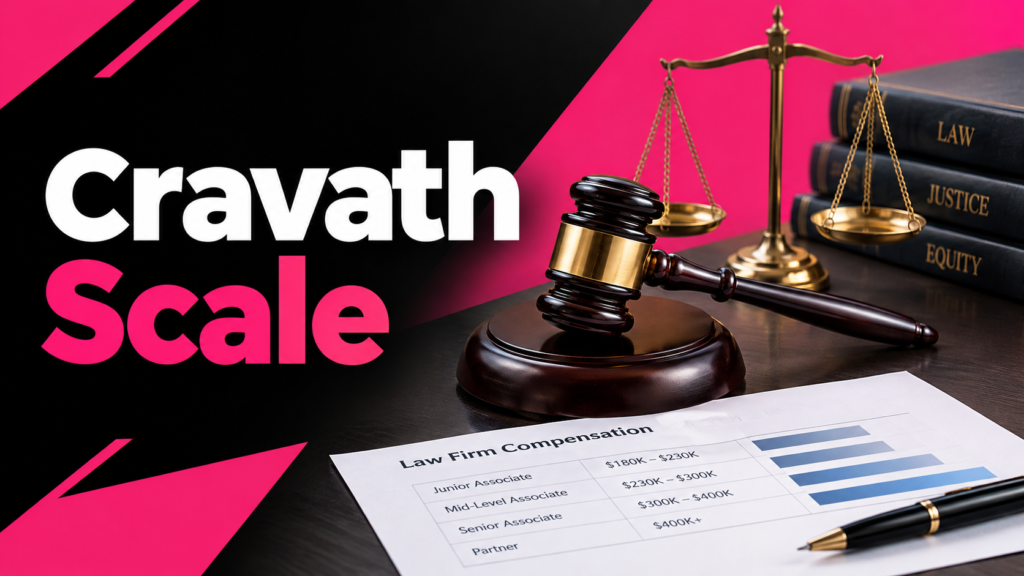

First-year associates at top U.S. firms now start at $235,000 in base salary, with eighth-years reaching $455,000 after the mid-2026 market reset. Yet many still wonder why their total take-home diverges from published figures once bonuses, hours thresholds, and firm tiers enter the picture.
This guide explains the Cravath scale, the lockstep benchmark that shapes Big Law associate compensation. It covers current base salaries, bonus structures, historical context, real gaps between published pay and actual earnings, and practical steps for associates, laterals, summer candidates, and recruiters evaluating offers or career moves.
Origins of the Cravath Scale and Lockstep Pay
The Cravath scale takes its name from Cravath, Swaine & Moore and the broader Cravath System developed by Paul Cravath in the early 20th century. That system professionalized large law firm practice: hire top graduates from elite schools, train them broadly through rotations, promote from within, and pay on a predictable seniority ladder rather than pure individual production.
Lockstep salary progression means associates of the same class year receive the same base salary, regardless of practice group or individual billings (within eligibility rules). The model promotes collegiality and reduces internal competition for work or credit. While Cravath modified pure lockstep for partners years ago, the associate version remains the market reference for most Am Law 100 firms.
Over decades the scale became industry shorthand. When a leading firm raises bases, peers typically match within weeks or months. Historically Cravath often set or confirmed the pace. In recent cycles, including the June 2026 increase, Milbank has frequently moved first. The label “Cravath scale” persists even when another firm leads the raise.
Current 2026 Big Law Salary Scale by Class Year
As of July 1, 2026, the prevailing market lockstep (set by Milbank and matched by numerous firms) runs as follows for base salary:
| Class Year | Base Salary |
|---|---|
| 1st year | $235,000 |
| 2nd year | $245,000 |
| 3rd year | $270,000 |
| 4th year | $320,000 |
| 5th year | $385,000 |
| 6th year | $410,000 |
| 7th year | $440,000 |
| 8th year+ | $455,000 |
These figures represent the post-raise grid. Junior classes received $10,000 increases; mid- and senior-level classes received $20,000. The prior market scale had held first-years at $225,000 for an extended period.
Note an important nuance: Cravath’s own public materials as of late September 2026 still listed a lower New York range ($225,000 to $420,000). Many firms and recruiters nevertheless treat the $235,000–$455,000 ladder as the operative market benchmark for negotiations and comparisons. Matching has been uneven: several Am Law firms and numerous boutiques adopted it promptly, while others delayed or matched only partially.
Summer associates at scale firms typically receive a weekly rate equal to the first-year base divided by 52. On the prior scale that was approximately $4,327; firms on the new scale adjust accordingly.
How Law Firm Bonuses Fit into the Picture
Base salary is only part of total compensation. Year-end and special bonuses can add substantial amounts, particularly for more senior associates.
The most recent widely matched year-end package came from Cravath’s November 18, 2025 memorandum. Approximate combined year-end plus special bonuses (the latter often $6,000–$25,000) reached:
- First-year (prorated): roughly $21,000
- Second-year: around $26,000
- Third-year: around $40,000
- Fourth-year: around $72,500
- Higher seniority: up to $115,000 year-end plus $25,000 special, for a top combined figure near $140,000
These amounts have been relatively stable in structure for several years, with special bonuses used as the more flexible lever. As of early October 2026, a full 2026 year-end scale had not yet been universally reset; firms continued referencing or matching the prior package while some issued additional specials (Milbank and Cahill among the early movers).
Total compensation for a first-year on the new base plus recent market bonuses often lands near $256,000–$261,000. Senior associates can approach $570,000–$595,000 when both base and full bonuses are realized. These are illustrative; actual receipts depend on eligibility.
The Real Gaps: Why Published Scales Differ from Take-Home Pay
Several factors create distance between the published big law salary scale and what associates actually receive.
Billable Hours Thresholds
Many firms condition full bonuses on meeting a billable-hour (or productive-hour) minimum, commonly 1,900–2,000 hours. Some add productive-time requirements that include training, recruiting, or innovation hours. Cravath itself has historically operated without a formal minimum for bonuses. Falling short can mean partial or zero bonus, shrinking total pay significantly.
Firm Tier and Geographic Variation
Not every Am Law 100 firm pays pure market scale in every office. Regional offices or mid-tier firms may pay below, especially outside major markets. NALP’s 2025 Associate Salary Survey (data as of January 1, 2025) showed an overall first-year median around $200,000 across participating offices, with larger firms closer to the then-prevailing scale. The top of the market remains concentrated among elite New York and national practices.
Bonus Variance and Discretion
Even when a firm announces a scale, individual performance, practice-group economics, or firm-wide results can affect special or high-performer add-ons. Some firms pay extra for exceptional productivity; others compress at the senior end.
Lateral Placement and Credit
Laterals rarely receive pure lockstep credit for every prior year. Class-year assignment, practice demand, and negotiation determine where they land on the scale. A lateral move can improve or dilute total compensation depending on the new firm’s hours culture, bonus reliability, and non-cash benefits.
These gaps matter most when comparing offers or deciding whether to stay or leave. Base salary provides predictability; bonuses and hours rules introduce variability that affects lifestyle and long-term earnings.
Evaluating Lateral Moves and Career Decisions
When assessing a lateral opportunity or internal progression, look beyond the headline base.
- Confirm the exact class-year placement and whether the firm follows the current market scale or a lagging one.
- Ask about historical bonus payment rates and any hours thresholds (including how pro bono or firm-service hours count).
- Compare total compensation over a multi-year horizon rather than a single year. A firm with slightly lower base but more reliable full bonuses and better work allocation can outperform on paper.
- Factor non-cash elements: partnership track transparency, practice strength, training, and exit options.
- For senior associates, examine whether the firm’s senior-associate or counsel compensation continues lockstep progression or shifts to more discretionary models.
Recruiters and partners evaluating candidates should treat the published scale as a floor for competitive offers in major markets, while recognizing that boutiques in high-demand litigation practices sometimes exceed it. Transparency on hours and bonus history builds stronger retention and hiring outcomes.
Practical Takeaways for Associates and Candidates
Track the market through reliable sources rather than rumor. The scale moves in discrete steps, usually after one or two leading firms act. Summer associates should confirm the weekly rate and how it converts to first-year base. Mid-level associates should model after-tax, after-hours total compensation when comparing firms. Partners and firm leaders should monitor matching rates carefully: lagging the market raises attrition risk among high performers.
The Cravath scale remains the clearest public benchmark for associate pay in elite U.S. firms. Understanding its structure, the role of bonuses, and the practical frictions around hours and firm differences gives professionals a sharper tool for career decisions.
Frequently Asked Questions
What is the Cravath scale in 2026?
It refers to the lockstep associate base salary progression used by many top firms. The prevailing market version effective mid-2026 starts at $235,000 for first-years and reaches $455,000 for eighth-years, though Cravath’s own published figures lagged that increase as of late September 2026.
How does the Cravath scale differ from the Milbank scale?
They describe the same lockstep concept at different moments. Milbank has led several recent raises, including the 2026 increase; the resulting grid is still widely called the Cravath scale.
Do all Big Law firms pay the full scale?
No. Matching is firm- and office-specific. Many Am Law 100 firms aim for market, but some offices or firms pay below, and a smaller group of boutiques sometimes pay above.
What are typical Big Law bonuses on top of the scale?
Recent market packages have combined year-end and special bonuses ranging from roughly $20,000–$25,000 for juniors (prorated for new first-years) up to about $140,000 for senior associates, subject to eligibility rules.
How do billable hours affect compensation?
Many firms require 1,900–2,000 billable or productive hours for full bonus eligibility. Missing the threshold can reduce or eliminate the bonus portion of total pay.
Should laterals expect pure lockstep credit?
Rarely automatic. Placement depends on experience, practice needs, and negotiation. Always confirm class-year assignment and bonus eligibility in writing.
Is the scale the same outside New York?
National firms often apply market scale in major U.S. offices, but regional variation and office-specific policies exist. Always verify the specific office.
You May Also Like: Mastering the Role of a Litigation Paralegal: From Discovery to Trial