
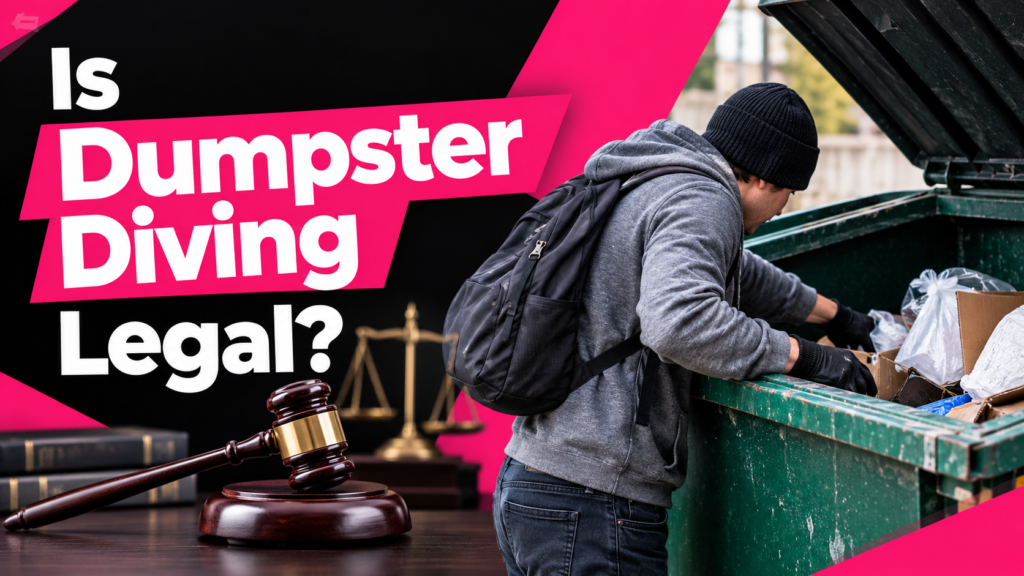

Imagine pulling a perfectly good pair of sneakers or a bag of unopened groceries from a dumpster behind a store. For budget-conscious students, freegans, and sustainability advocates, that moment feels like a win against waste. Yet one question hangs over every haul: Is dumpster diving legal?
The short answer is yes in many situations, but the full picture is more complicated. Federal law does not ban the practice. A landmark Supreme Court case treats discarded trash in public areas as fair game. Still, private property rights, local scavenging ordinances, and trespassing laws can turn a legal activity into a citation or arrest. This guide explains the legal landscape across the United States so you can understand the risks and make informed choices.
The Federal Foundation: California v. Greenwood
In 1988, the U.S. Supreme Court decided California v. Greenwood. Police in Laguna Beach suspected Billy Greenwood of drug activity. They asked the trash collector to hand over bags Greenwood had left at the curb. Officers searched the bags without a warrant, found evidence, and used it to get a search warrant for the house.
Greenwood argued the search violated the Fourth Amendment. The Court disagreed in a 6-2 decision. It held that there is no reasonable expectation of privacy in garbage left for collection outside the home’s curtilage. Plastic bags on a public street are “readily accessible to animals, children, scavengers, snoops, and other members of the public.” By placing trash out for a third-party collector, the owner abandons any claim to privacy.
This ruling is the starting point for dumpster diving laws nationwide. It means law enforcement can search curbside trash without a warrant. By extension, private citizens face no federal prohibition against taking discarded items from publicly accessible areas. The abandoned property doctrine supports this view: once someone throws something away in a public place, they generally relinquish ownership.
Important caveat: Greenwood addresses Fourth Amendment privacy against the government. It does not create a blanket right for civilians to enter any property or ignore local rules. The Court itself noted that its decision would not override city, county, or state laws restricting the practice.
No federal statute bans dumpster diving. No state has passed a statewide ban either. Legality therefore turns on location, access, and local rules.
When Dumpster Diving Is Generally Legal
Dumpster diving stays on the right side of the law under these conditions:
- The dumpster or trash sits in a publicly accessible area, such as the curb on collection day or an open public alley.
- You do not cross onto private property without permission.
- No fences, locked gates, chains, or enclosures block access.
- No “No Trespassing,” “Private Property,” or “No Scavenging” signs are posted.
- Local ordinances do not prohibit the removal of refuse or recyclables.
- You leave the area clean and do not create a disturbance.
Curbside household trash and bulk items set out for municipal pickup are the safest targets. Once they leave private property and enter the public right-of-way, most courts treat them as abandoned. Taking them is not theft.
Open dumpsters in truly public spaces follow the same logic. The private property rights of the original owner end when the items are discarded in a place the public can reach without trespassing.
When Dumpster Diving Crosses into Illegal Territory
Most legal trouble comes from three areas: trespassing, local ordinances, and how you conduct yourself.
Trespassing While Dumpster Diving
Trespassing while dumpster diving is the charge people face most often. Nearly every commercial dumpster sits on private property. Walking behind a store, entering a fenced loading dock, climbing a gate, or cutting across a private parking lot without permission can constitute criminal trespass.
Many states treat unauthorized entry onto private land as a misdemeanor even without posted signs. Signs make the case stronger for prosecutors because they prove the entrant had notice. Locked dumpsters send an even clearer message. Bypassing a lock or damaging an enclosure can add charges for property damage or vandalism.
Apartment complexes, college campuses, and shopping centers almost always count as private property. A public parking lot in front of a store does not automatically make the dumpster behind the building public. If you have to leave the area open to the general public, you are likely trespassing.
Local Scavenging Ordinances and Municipal Garbage Laws
Cities and counties fill the gap left by federal and state law. Hundreds of municipalities have scavenging ordinances or municipal garbage laws that restrict or ban removing items from trash or recycling containers.
These rules often protect municipal recycling programs. Once residents place recyclables at the curb, the city or its contracted hauler may claim ownership under the waste management contract. Taking aluminum cans or cardboard can be treated as interference with that contract or as a form of recycling bin theft.
Examples exist across the country. Some California cities, including parts of Los Angeles and smaller municipalities, prohibit scavenging from residential or commercial containers. New York City has rules limiting the unauthorized removal of recyclable materials. Chicago and other major cities maintain similar restrictions. Fines typically range from $100 to several hundred dollars for a first offense. Repeat violations can escalate.
Enforcement varies. Some cities actively patrol on trash day. Others respond only to complaints. The only reliable way to know the rules is to check your city or county municipal code under solid waste, sanitation, or refuse sections. Search terms like “scavenging,” “unauthorized removal,” or “recyclable materials” usually surface the relevant language.
Other Potential Charges
Even when trespass and scavenging rules do not apply, other issues can arise:
- Disorderly conduct charges if you scatter trash, make excessive noise, or create a mess.
- Theft claims if the items are not fully abandoned (rare for true trash, more common if a business still claims ownership inside a locked enclosure).
- Health or safety citations in some jurisdictions if the activity interferes with waste collection.
Nighttime diving is not inherently illegal, but it increases the chance of police contact. Officers may view late-night activity near commercial properties as suspicious. College campuses often have their own security rules that treat the entire grounds as private.
Practical Rules for Minimizing Legal Risk
If you decide to dive, treat these practices as non-negotiable:
- Research local ordinances first. Search “[your city] municipal code scavenging” or call the non-emergency police line and ask about rules for removing discarded items.
- Stay on public property or get explicit permission. Asking a store manager is safer than assuming.
- Avoid locked, fenced, or posted dumpsters. If access requires force or climbing, walk away.
- Leave the area cleaner than you found it. Scatter nothing. Close lids.
- Dive during daylight when possible. Visibility reduces misunderstanding.
- Never take items that look personal or contain private information. Identity-related materials raise separate concerns.
- For food, understand the health risks as well as the legal ones. Spoiled or contaminated items can cause illness regardless of legality.
These steps do not create immunity, but they dramatically lower the odds of a citation or arrest. Most people who face charges ignored clear barriers or local bans.
Special Situations Readers Often Ask About
Is dumpster diving legal on private property? Almost never without permission. Private property rights control access. Trespassing laws apply nationwide.
Is dumpster diving legal if the dumpster is locked? No. A lock signals the owner’s intent to exclude others. Forcing entry can lead to additional charges.
Is dumpster diving legal near college campuses? Campuses are usually private property. Campus security and local trespass rules apply. Check with the school.
Is dumpster diving legal at night? The time of day does not change the underlying property or ordinance rules. It does raise practical risks of confrontation or police stops.
Is dumpster diving legal in public parking lots? The lot itself may be open to the public, but the dumpster enclosure behind the building is often still private. Location of the container matters more than the parking surface.
Is dumpster diving legal for food? The same property and ordinance rules apply. Health codes may add separate considerations in some areas. Food rescue organizations offer safer, fully legal alternatives.
Is dumpster diving legal with no trespassing signs? Signs remove ambiguity. Entering after notice is stronger evidence of knowing trespass.
Is dumpster diving legal in Kansas? Kansas has no statewide ban. The same federal baseline and trespassing rules apply. Local cities may have their own ordinances, so check municipal codes. Criminal trespass is a Class B misdemeanor.
Is dumpster diving legal if I leave it clean? Leaving the area tidy helps avoid disorderly conduct claims, but it does not erase trespass or ordinance violations.
Real-World Consequences and Enforcement Patterns
Enforcement is uneven. Many divers report years of activity without incident when they stay in open public areas and keep a low profile. Problems arise most often when property owners call police, when divers ignore posted signs, or when local anti-scavenging teams are active on collection days.
Penalties usually start as infractions or low-level misdemeanors: fines of $100–$1,000 and, in serious trespass cases, possible short jail time. Civil lawsuits for trespass are possible but less common. A clean record in one city means nothing a few miles away if the neighboring town has different rules.
Waste management contracts sometimes give haulers exclusive rights to the materials once placed for collection. In those jurisdictions, removing recyclables can be treated as interference with a municipal contract even on the public curb.
Balancing Sustainability Goals with Legal Reality
Many people turn to dumpster diving out of genuine concern about food waste, overconsumption, and landfill pressure. Those motivations are understandable. The legal system, however, prioritizes property rights and orderly waste collection. Local governments invest in recycling programs and contract with haulers. When scavengers remove high-value materials, the economics of those programs suffer. That is why so many cities adopted anti-scavenging rules.
Safer alternatives exist. Food rescue nonprofits, community fridges, Buy Nothing groups, and official bulk-item collection days often provide legal access to usable goods. Some stores donate surplus rather than discarding it. Building relationships with managers can open doors that trespassing never will.
Conclusion
Is dumpster diving legal? Under federal law and in the absence of local restrictions, taking discarded items from publicly accessible areas is generally permitted because of the abandoned property principle established in California v. Greenwood. The moment you step onto private property, ignore locks or signs, or violate a municipal scavenging ordinance, the activity becomes illegal.
The difference between a successful haul and a citation almost always comes down to location and local rules. Check your city code. Respect property boundaries. Leave every site clean. Those habits keep the practice within the law for most people most of the time.
If you face a citation or have a specific situation involving your city’s ordinances, consult a local attorney who understands municipal and property law. Rules change, and only a qualified professional can give advice tailored to your exact circumstances.
Frequently Asked Questions
Is dumpster diving legal in my city?
It depends on local ordinances. Search your municipal code for “scavenging,” “refuse,” or “recyclables.” No two cities are identical.
Can I be charged with theft for taking trash?
Usually no if the items are truly abandoned in a public area. Theft claims are rare for ordinary trash but can arise if a locked enclosure or contractual ownership is involved.
Does California v. Greenwood make dumpster diving legal everywhere?
It removes federal privacy barriers for curbside trash. It does not override trespassing laws or local bans.
What if there are no signs but the dumpster is behind a store?
Absence of signs does not make private property public. Most commercial lots and loading areas remain private.
Are recycling bins treated differently from regular dumpsters?
Often yes. Many cities protect recyclables more strictly because of municipal programs and contracts.
Can businesses sue me for dumpster diving?
They can pursue civil trespass claims. Criminal charges are more common than private lawsuits.
Is it legal to sell items found while dumpster diving?
If the items were legally obtained as abandoned property, selling them is generally allowed. Selling items taken through trespass or in violation of an ordinance can create additional problems.
You May Also Like: From Allegation to Outcome: A Legal Guide to Claims, Evidence, and Verdicts